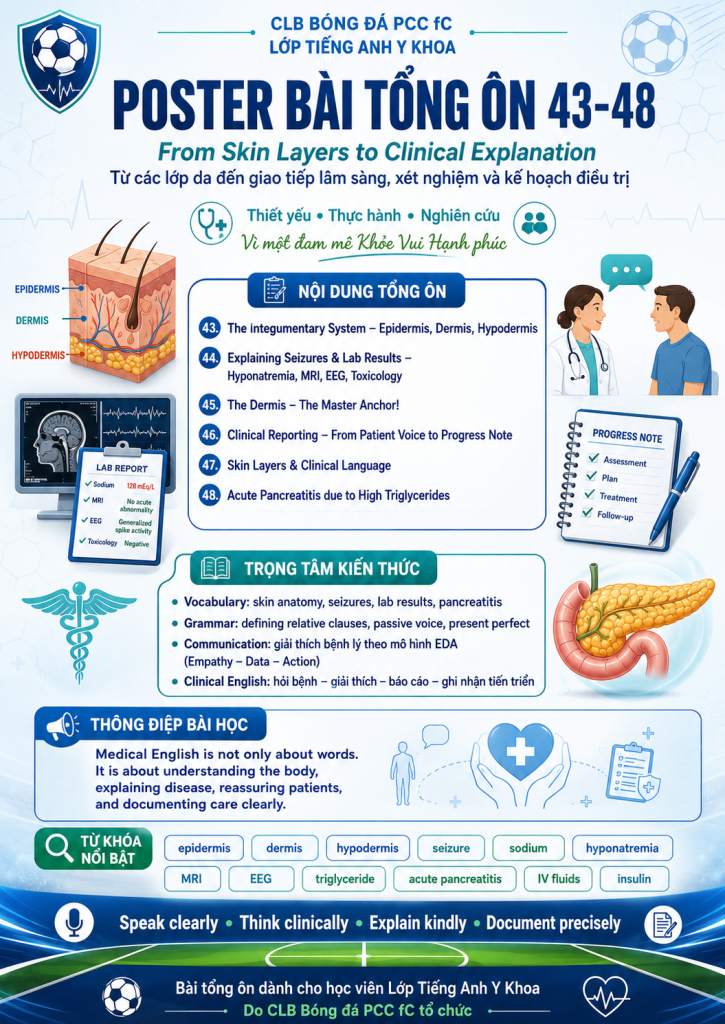
Bài tổng ôn 43-48 – Tiếng Anh Y Khoa: Từ các lớp da đến giải thích lâm sàng * From Skin Layers to Clinical Explanation
PCC Language – Thăng Long, Hà Nội, 4/7/2026, Sau 6 bài học liên tiếp, hôm nay chúng ta cùng dừng lại để tổng ôn một hành trình rất ý nghĩa của Tiếng Anh Y khoa: từ các lớp da như epidermis, dermis, hypodermis, đến cách giải thích co giật do hạ natri máu, báo cáo MRI, EEG, toxicology screening, ghi nhận tiến triển lâm sàng và trao đổi với người bệnh viêm tụy cấp do tăng triglyceride. Bài học hôm nay không chỉ giúp chúng ta nhớ từ vựng, mà quan trọng hơn là rèn cách dùng tiếng Anh để hỏi bệnh rõ ràng, giải thích dễ hiểu, trấn an người bệnh và ghi nhận lâm sàng chính xác. Từ một thuật ngữ giải phẫu nhỏ đến một kế hoạch điều trị hoàn chỉnh, mỗi câu tiếng Anh đều có thể trở thành cây cầu kết nối giữa kiến thức y khoa, giao tiếp nhân văn và chăm sóc người bệnh tốt hơn.
BÀI TỔNG ÔN TIẾNG ANH Y KHOA 43–48
From Skin Layers to Clinical Explanation
Từ các lớp da đến giao tiếp lâm sàng, xét nghiệm và kế hoạch điều trị
Lớp Tiếng Anh Y Khoa – CLB Bóng đá PCC fC
Tinh thần: Thiết yếu – Thực hành – Nghiên cứu – Khỏe Vui Hạnh phúc
Thời lượng gợi ý: 30–35 phút
Phiên bản rút gọn: 25 phút cho lớp 5 giờ sáng
1. Đoạn dẫn mở bài
Good morning, everyone.
Trong 6 bài gần đây, chúng ta đã đi qua một hành trình rất đẹp của Tiếng Anh Y khoa: từ hệ da – nơi cơ thể tiếp xúc với môi trường, đến lớp bì – mỏ neo sinh học của làn da; từ co giật do hạ natri máu – nơi bác sĩ cần giải thích xét nghiệm một cách bình tĩnh, đến viêm tụy cấp do tăng triglyceride – nơi người bệnh cần được hỏi bệnh, trấn an và hiểu kế hoạch điều trị.
Bài tổng ôn hôm nay không chỉ giúp chúng ta nhớ từ vựng. Quan trọng hơn, bài học giúp chúng ta biết cách định nghĩa đúng, hỏi đúng, giải thích đúng, báo cáo đúng và ghi nhận đúng.
Key message:
Medical English is not only about words.
It is about using language to understand the body, explain disease, reassure patients, and document care clearly.
2. Mục tiêu bài tổng ôn
Sau bài học, học viên có thể:
- Gọi tên và mô tả 3 lớp chính của da: epidermis, dermis, hypodermis / subcutaneous layer.
- Dùng defining relative clauses để định nghĩa cấu trúc, bệnh lý và triệu chứng.
- Dùng passive voice để mô tả giải phẫu – sinh lý và thủ thuật.
- Dùng Present Perfect để báo cáo việc đã làm: xét nghiệm, chẩn đoán, điều trị.
- Giải thích nguyên nhân bệnh bằng cấu trúc: may have caused / has caused / can lead to.
- Áp dụng mô hình EDA: Empathy – Data – Action để trấn an người bệnh.
- Chuyển từ lời bệnh nhân sang ngôn ngữ bệnh án / progress note ngắn gọn.
3. Bản đồ tổng ôn 6 bài
| Bài | Chủ đề | Từ khóa chính | Ngữ pháp / kỹ năng |
| Bài 43 | The Integumentary System | epidermis, dermis, hypodermis, keratin, melanin, sebum | Defining relative clauses: that / which / who |
| Bài 44 | Seizures & Lab Results | seizure, sodium, hyponatremia, MRI, EEG, toxicology screening | Present Perfect + EDA communication |
| Bài 45 | The Dermis – The Master Anchor | connective tissue, collagen, elastin, blister, callus, follicle | Passive voice + relative clauses |
| Bài 46 | Clinical Reporting Bridge | patient reports, assessment suggests, progress note, monitor closely | From patient voice to medical record |
| Bài 47 | Skin Layers & Clinical Language | epidermis, dermis, hypodermis, subcutaneous layer, adipose tissue | Passive voice, comparison, documentation |
| Bài 48 | Acute Pancreatitis due to High Triglycerides | upper abdominal pain, vomiting, triglyceride, insulin, IV fluids | Present Perfect with “for” + cause–effect explanation |
4. Từ vựng trọng tâm có phiên âm
| English | Pronunciation | Vietnamese | Clinical sentence |
| epidermis | /ˌepɪˈdɜːrmɪs/ | biểu bì | The epidermis is the outer layer of the skin. |
| dermis | /ˈdɜːrmɪs/ | lớp bì | The dermis lies beneath the epidermis. |
| hypodermis | /ˌhaɪpoʊˈdɜːrmɪs/ | hạ bì | The hypodermis contains adipose tissue. |
| subcutaneous layer | /ˌsʌbkjuːˈteɪniəs ˈleɪər/ | lớp dưới da | In clinical practice, we often call it the subcutaneous layer. |
| connective tissue | /kəˈnektɪv ˈtɪʃuː/ | mô liên kết | Connective tissue anchors the skin. |
| collagen | /ˈkɑːlədʒən/ | collagen | Collagen provides strength. |
| elastin | /ɪˈlæstɪn/ | sợi đàn hồi | Elastin allows the skin to stretch. |
| blister | /ˈblɪstər/ | phỏng rộp | Acute friction may cause a blister. |
| callus | /ˈkæləs/ | vết chai | Chronic friction may form a callus. |
| seizure | /ˈsiːʒər/ | cơn co giật | The patient had a seizure at home. |
| sodium | /ˈsoʊdiəm/ | natri | Your sodium level is very low. |
| hyponatremia | /ˌhaɪpoʊnəˈtriːmiə/ | hạ natri máu | Hyponatremia may cause seizures. |
| toxicology screening | /ˌtɑːksɪˈkɑːlədʒi ˈskriːnɪŋ/ | tầm soát độc chất | We have ordered toxicology screening. |
| MRI | /ˌem ɑːr ˈaɪ/ | cộng hưởng từ | Your MRI shows no new bleeding. |
| EEG | /ˌiː iː ˈdʒiː/ | điện não đồ | Your EEG is currently normal. |
| acute pancreatitis | /əˈkjuːt ˌpæŋkriəˈtaɪtɪs/ | viêm tụy cấp | High triglycerides can cause acute pancreatitis. |
| triglyceride | /traɪˈɡlɪsəraɪd/ | triglyceride | Your triglyceride level is very high. |
| IV fluids | /ˌaɪ ˈviː ˈfluːɪdz/ | dịch truyền tĩnh mạch | We will give you IV fluids. |
| insulin | /ˈɪnsəlɪn/ | insulin | Insulin can help lower triglyceride levels. |
| monitor closely | /ˈmɑːnɪtər ˈkloʊsli/ | theo dõi sát | We will monitor you closely. |
5. Ôn ngữ pháp trọng tâm
A. Defining relative clauses – Mệnh đề quan hệ xác định
Dùng để định nghĩa rõ một cấu trúc, bệnh hoặc triệu chứng.
Công thức:
A / An + noun + is + a structure / condition / symptom + that / which + function.
Ví dụ:
- The epidermis is the outer layer that protects the body from bacteria.
- The dermis is the layer that contains blood vessels, nerves, glands, and follicles.
- A blister is a fluid-filled pocket that may form after acute friction.
- Acute pancreatitis is a condition that causes inflammation of the pancreas.
B. Passive voice – Câu bị động trong mô tả y khoa
Dùng khi muốn nhấn mạnh cấu trúc, xét nghiệm, thủ thuật hoặc kết quả.
Công thức:
S + is / are + V3/ed + by / with / in / of…
Ví dụ:
- The dermis is composed of connective tissue, blood vessels, nerves, glands, and follicles.
- The skin is protected by the epidermis.
- Body temperature is regulated by blood vessels and sweat glands.
- The patient is monitored closely in the ICU.
C. Present Perfect – Báo cáo việc đã làm
Dùng khi hành động đã thực hiện và còn ý nghĩa với hiện tại.
Công thức:
S + has / have + V3/ed
Ví dụ:
- We have ordered a comprehensive toxicology screening.
- We have checked your sodium level.
- The team has reviewed your MRI.
- The patient has had severe upper abdominal pain for three days.
D. Cause–effect explanation – Giải thích nguyên nhân
Dùng để nói rõ cơ chế bệnh nhưng vẫn dễ hiểu cho người bệnh.
Cấu trúc nên dùng:
- Your sodium level is very low, which may have caused the seizure.
- Your triglyceride level is very high, and this has caused acute pancreatitis.
- Acute friction may cause a blister.
- Chronic friction may lead to a callus.
6. Mô hình giao tiếp EDA
EDA = Empathy – Data – Action
1. Empathy – Thấu cảm
I understand this is worrying for you and your family.
Tôi hiểu điều này khiến anh/chị và gia đình lo lắng.
2. Data – Dữ liệu
Your blood tests show that your sodium level is very low.
Xét nghiệm máu cho thấy natri của anh/chị rất thấp.
Your MRI shows no new bleeding.
MRI não không thấy chảy máu mới.
3. Action – Hành động
We have ordered further tests and we will monitor you closely.
Chúng tôi đã chỉ định thêm xét nghiệm và sẽ tiếp tục theo dõi sát.
7. Hội thoại tổng ôn 12 câu
Clinical Review Dialogue: From Symptoms to Explanation
Doctor: Good morning. What symptoms brought you to the hospital?
Patient: I have had severe upper abdominal pain and vomiting for three days.
Doctor: Your triglyceride level is very high, and this has caused acute pancreatitis.
Patient: Is it dangerous, doctor?
Doctor: It can be serious, but your current severity assessment suggests a low risk at the moment.
Patient: How will you treat me?
Doctor: We will give you IV fluids, insulin, pain relief, and monitor your blood glucose and triglyceride levels closely.
Patient: Thank you, doctor. I will follow the treatment plan.
Student: Doctor, how should we explain a seizure caused by low sodium?
Doctor: Say: “Your sodium level is very low, which may have caused the seizure.”
Student: And how should we reassure the patient?
Doctor: Use EDA: empathy, data, and action. For example: “I understand this is worrying. Your MRI shows no new bleeding, and we will monitor you closely.”
8. Clinical reporting bridge – Cầu nối Bài 46
From patient voice to progress note
| Patient says | Doctor records |
| “I had a seizure at home.” | The patient had a witnessed seizure at home. |
| “I don’t remember much afterward.” | Post-ictal memory loss was reported. |
| “I have had severe upper abdominal pain for three days.” | The patient reports severe upper abdominal pain for three days. |
| “I have been vomiting.” | Vomiting was reported. |
| “Is my brain damaged?” | The patient expressed concern about possible brain injury. |
| “I feel better now.” | Symptoms are improving. Continue monitoring. |
Mini progress note
Progress note:
The patient reports severe upper abdominal pain and vomiting for three days. Blood tests show markedly elevated triglyceride levels, consistent with acute pancreatitis due to hypertriglyceridemia. Current severity assessment suggests low risk at the moment. Plan: IV fluids, insulin, pain relief, monitoring of blood glucose and triglyceride levels, and close clinical observation.
9. Thực hành nhóm trên lớp
Station 1 – Skin anatomy
Học viên A hỏi:
What are the three main layers of the skin?
Học viên B trả lời:
The three main layers of the skin are the epidermis, dermis, and hypodermis.
Học viên C nâng cấp:
The epidermis is the outer layer that protects the body, while the dermis contains blood vessels, nerves, glands, and follicles.
Station 2 – Dermis mechanism
Prompt: Explain blister and callus.
Suggested answer:
A blister is a fluid-filled pocket that may form after acute friction. A callus is thickened skin that may develop after chronic friction.
Station 3 – Seizure and sodium
Prompt: Explain low sodium to a patient.
Suggested answer:
Your sodium level is very low, which may have caused the seizure. We have ordered further tests and will continue to monitor you closely.
Station 4 – Acute pancreatitis
Prompt: Explain the treatment plan.
Suggested answer:
We will give you IV fluids, insulin, pain relief, and monitor your blood glucose and triglyceride levels closely.
10. Mini-test cuối bài
A. Fill in the blanks
- The ________ is the outer layer of the skin.
- The dermis lies beneath the ________.
- The hypodermis is also called the ________ layer.
- A ________ is a fluid-filled pocket after acute friction.
- A ________ may form after chronic friction.
- The patient had a ________ at home.
- Your ________ level is very low.
- We have ordered a toxicology ________.
- High triglycerides can cause acute ________.
- We will monitor you ________.
Answer key
- epidermis
- epidermis
- subcutaneous
- blister
- callus
- seizure
- sodium
- screening
- pancreatitis
- closely
11. Bài tập nói nhanh
Mỗi học viên chọn 1 câu và nói to, rõ, đúng nhịp:
- The epidermis is the outer layer that protects the body.
- The dermis is composed of connective tissue, blood vessels, nerves, glands, and follicles.
- The hypodermis contains adipose tissue.
- Your sodium level is very low, which may have caused the seizure.
- We have ordered a comprehensive toxicology screening.
- Fortunately, your MRI shows no new bleeding.
- Your triglyceride level is very high, and this has caused acute pancreatitis.
- We will give you IV fluids, insulin, and pain relief.
- We will continue to monitor you closely.
- Medical English helps us care better.
12. Bài tập về nhà
Viết 5 câu tiếng Anh theo các mẫu sau:
- The epidermis is…
- The dermis is composed of…
- Your blood test shows…
- We have ordered…
- We will continue to…
Ví dụ:
The dermis is composed of connective tissue, blood vessels, nerves, glands, and follicles.
Your blood test shows that your sodium level is very low.
We have ordered a comprehensive toxicology screening.
We will continue to monitor you closely.
13. Đoạn kết truyền cảm hứng
Bài tổng ôn hôm nay nhắc chúng ta rằng: học Tiếng Anh Y khoa không phải là học từng từ rời rạc. Đó là học cách nhìn cơ thể người bệnh bằng kiến thức, diễn đạt bằng ngôn ngữ chính xác, và chăm sóc bằng trái tim nhân văn.
Từ epidermis đến dermis, từ sodium đến triglyceride, từ seizure đến acute pancreatitis, mỗi thuật ngữ đều có thể trở thành một cây cầu: cầu nối giữa bác sĩ và người bệnh, giữa sinh viên và tri thức, giữa PCC fC và y học quốc tế.
Speak clearly. Think clinically. Explain kindly. Document precisely.
Nói rõ ràng – Nghĩ lâm sàng – Giải thích nhân văn – Ghi nhận chính xác.
Đó là tinh thần của Lớp Tiếng Anh Y Khoa PCC fC:
Thiết yếu – Thực hành – Nghiên cứu – Khỏe Vui Hạnh phúc.
CLB PCC fC