Bài 90 – Tiếng Anh Y Khoa: Tối ưu hóa trước phẫu thuật ở người bệnh gãy cổ xương đùi có biến chứng nội khoa
PCC Language – Thăng Long, Hà Nội, ngày 22/8/2026, Ở người cao tuổi, một gãy cổ xương đùi di lệch hiếm khi chỉ là vấn đề của riêng ngoại khoa. Khi chấn thương xuất hiện đồng thời với tổn thương thận cấp, tăng kali máu nặng, nhiễm khuẩn, thiếu máu và suy tim, quyết định “mổ ngay hay trì hoãn” trở thành một bài toán lâm sàng phức tạp, đòi hỏi sự phối hợp chặt chẽ giữa Hồi sức, Thận học, Tim mạch, Gây mê và Chấn thương chỉnh hình. Bài 90 của Lớp Tiếng Anh Y Khoa 5H sáng do CLB Bóng đá PCC fC tổ chức sẽ sử dụng chính tình huống thực tế này để rèn luyện đồng thời ngôn ngữ chuyên ngành và tư duy lâm sàng: nhận diện nguy cơ chu phẫu, ưu tiên xử trí các bất thường nguy hiểm nhưng có thể hồi phục, đánh giá nguyên nhân tổn thương thận, cân bằng giữa tưới máu và sung huyết, đồng thời tránh trì hoãn không cần thiết điều trị triệt để. Thông điệp cốt lõi của bài học là: “Optimization does not mean perfection” – tối ưu hóa không có nghĩa là phải đưa mọi con số về hoàn hảo, mà là đưa người bệnh đến trạng thái đủ an toàn để được điều trị đúng lúc, đúng cách và tốt nhất có thể.
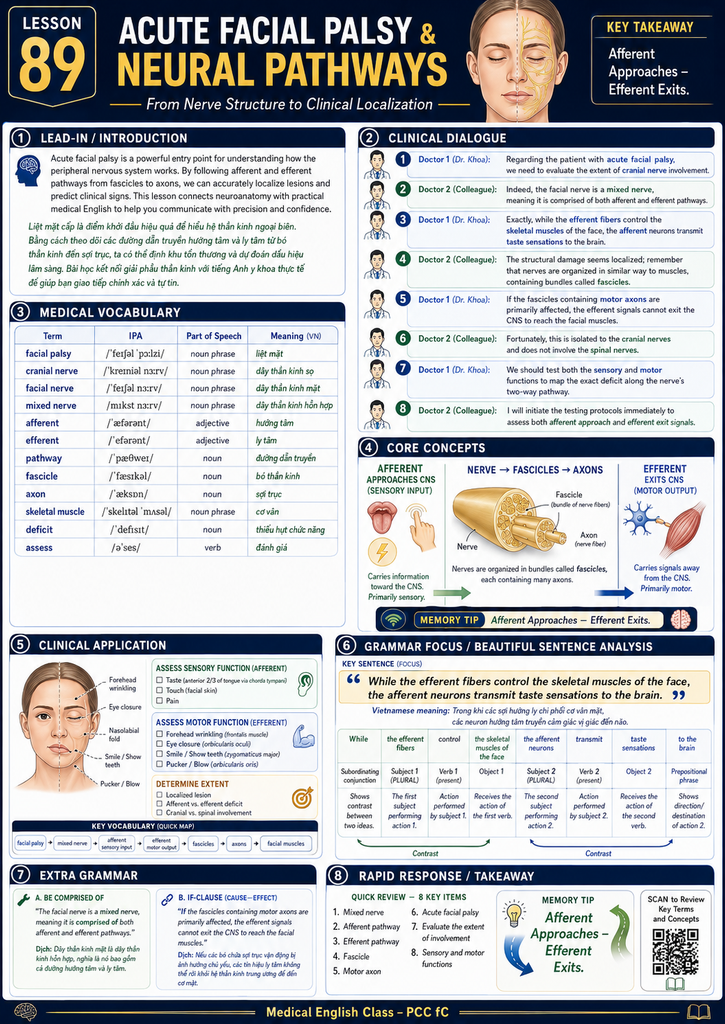
In older adults, a displaced femoral neck fracture is rarely an orthopedic problem alone. When the injury occurs alongside acute kidney injury, severe hyperkalemia, infection, anemia, and heart failure, the decision of whether to “operate immediately or delay surgery” becomes a complex clinical challenge requiring close collaboration among intensive care specialists, nephrologists, cardiologists, anesthesiologists, and orthopedic surgeons.
Lesson 90 of the 5 AM Medical English Class, organized by PCC fC Football Club, uses this real-world clinical scenario to develop both medical English and clinical reasoning skills. Learners will practice identifying perioperative risks, prioritizing dangerous but reversible abnormalities, evaluating the causes of acute kidney injury, balancing renal perfusion against venous congestion, and avoiding unnecessary delays in definitive treatment.
The central message of this lesson is:
“Optimization does not mean perfection.”
Preoperative optimization does not mean bringing every laboratory value back to normal. Rather, it means making the patient sufficiently stable and safe to receive the right definitive treatment, at the right time, in the most appropriate way possible.
�� BÀI 90 – LỚP TIẾNG ANH Y KHOA 5H SÁNG
TỐI ƯU HÓA TRƯỚC PHẪU THUẬT Ở NGƯỜI BỆNH GÃY CỔ XƯƠNG ĐÙI CÓ BIẾN CHỨNG NỘI KHOA
PREOPERATIVE OPTIMIZATION IN A PATIENT WITH FEMORAL NECK FRACTURE AND ACUTE MEDICAL COMPLICATIONS
Tổ chức bởi CLB Bóng đá PCC fC
I. LEAD-IN – DẪN NHẬP
A 68-year-old woman was admitted after a fall and was diagnosed with a displaced left femoral neck fracture. However, the fracture was only one part of the clinical problem. She also had acute kidney injury, severe hyperkalemia, suspected urinary tract infection, anemia, bilateral leg edema, and a history of heart failure.
The orthopedic team considered surgery necessary, but immediate surgery could expose the patient to substantial anesthetic and perioperative risk. The multidisciplinary team therefore faced a critical question:
How can we correct the dangerous reversible abnormalities without unnecessarily delaying definitive surgical treatment?
This case illustrates one of the most important principles of perioperative medicine: preoperative optimization does not mean waiting until every laboratory value is normal. It means identifying what truly threatens the patient, correcting what is reversible, and moving toward definitive treatment at the safest appropriate time.
Dịch
Một bệnh nhân nữ 68 tuổi nhập viện sau ngã và được chẩn đoán gãy cổ xương đùi trái có di lệch. Tuy nhiên, gãy xương chỉ là một phần của vấn đề lâm sàng. Người bệnh đồng thời có tổn thương thận cấp, tăng kali máu nặng, nghi ngờ nhiễm khuẩn tiết niệu, thiếu máu, phù hai chi dưới và tiền sử suy tim.
Nhóm Chấn thương chỉnh hình xác định bệnh nhân cần phẫu thuật, nhưng phẫu thuật ngay khi các rối loạn nội khoa chưa được kiểm soát có thể làm tăng đáng kể nguy cơ gây mê và biến chứng chu phẫu. Vì vậy, nhóm đa chuyên khoa phải trả lời một câu hỏi rất quan trọng:
Làm thế nào để nhanh chóng điều chỉnh những bất thường nguy hiểm có thể hồi phục mà không trì hoãn không cần thiết việc điều trị phẫu thuật triệt để?
Ca bệnh nhấn mạnh một nguyên tắc cốt lõi của y học chu phẫu: tối ưu hóa trước mổ không có nghĩa là phải đợi mọi xét nghiệm trở về bình thường. Điều quan trọng là nhận diện yếu tố thực sự đe dọa người bệnh, điều chỉnh những bất thường có thể đảo ngược và tiến tới điều trị triệt để vào thời điểm phù hợp, an toàn nhất.
II. LEARNING OBJECTIVES – MỤC TIÊU BÀI HỌC
Sau bài học, học viên có thể:
- Mô tả một ca displaced femoral neck fracture bằng tiếng Anh y khoa.
- Trình bày các yếu tố làm tăng perioperative risk.
- Thảo luận nguyên nhân và xử trí ban đầu của acute kidney injury and hyperkalemia.
- Phân tích mối quan hệ giữa heart failure, venous congestion, renal perfusion and fluid therapy.
- Sử dụng ngôn ngữ chuyên môn để trao đổi trong hội chẩn đa chuyên khoa.
- Phân biệt optimization với việc cố gắng “normalize every laboratory value”.
- Thực hành diễn đạt quyết định surgical readiness / clearance for surgery.
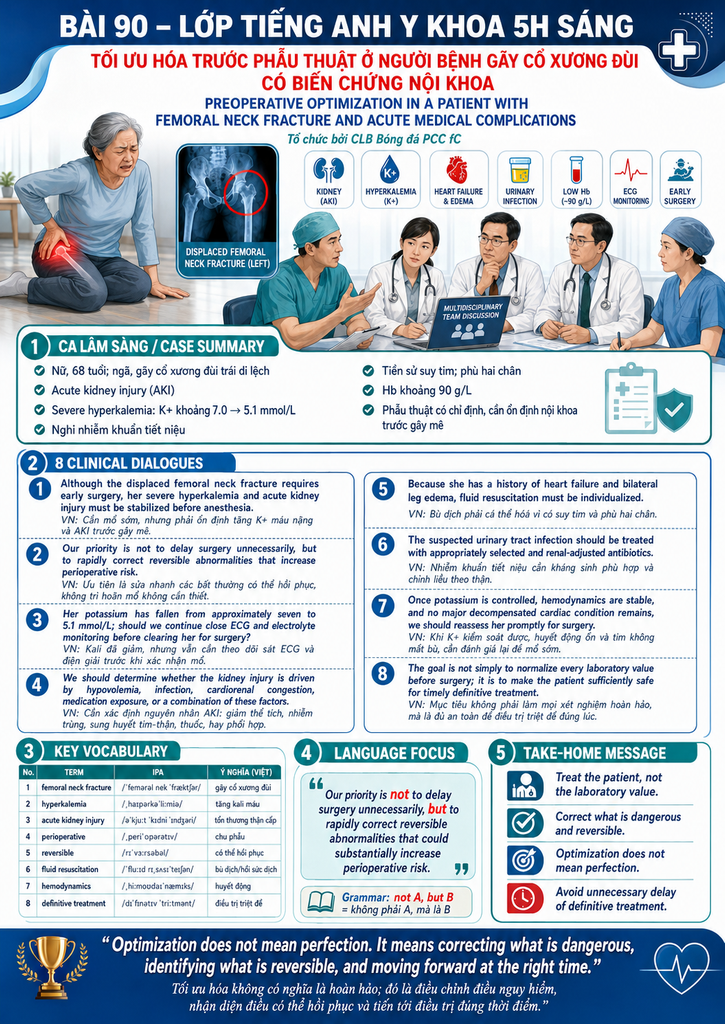
III. CASE SUMMARY – TÓM TẮT CA BỆNH
Patient: 68-year-old woman
Mechanism: Fall
Major injury: Displaced left femoral neck fracture with a detached bone fragment
Associated medical problems:
- Acute kidney injury
- Severe hyperkalemia, initially approximately 7.0 mmol/L
- Potassium subsequently decreased to approximately 5.1 mmol/L
- Suspected urinary tract infection
- History of heart failure
- Bilateral leg edema
- Hemoglobin approximately 90 g/L
- Preserved distal pulse in the affected limb
Orthopedic assessment: Surgery is indicated, but temporary postponement is required for medical stabilization.
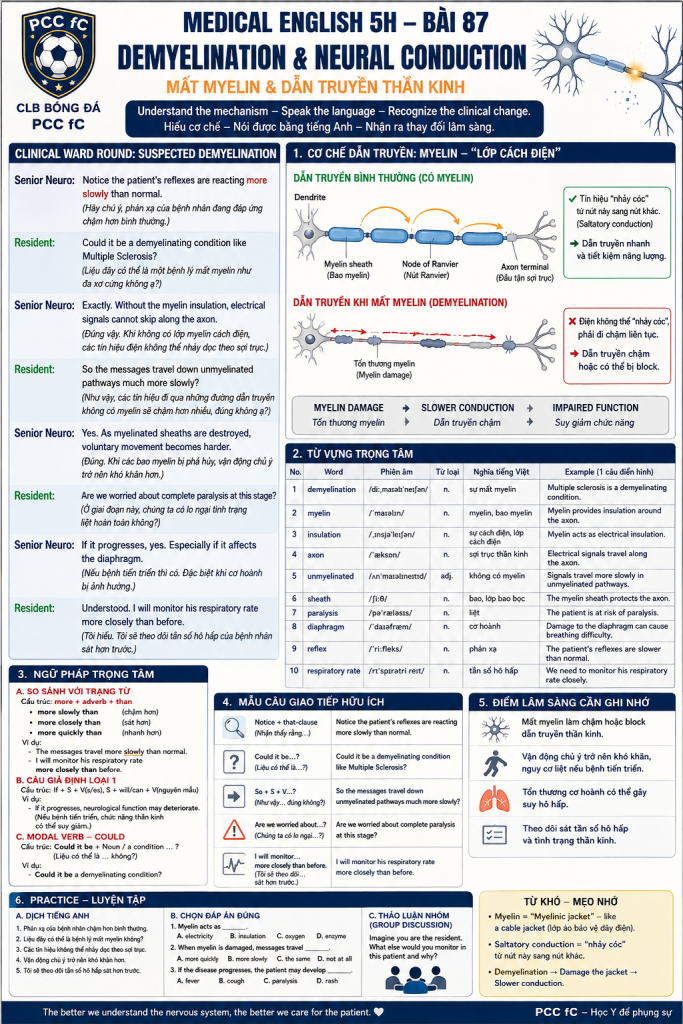
IV. CLINICAL DIALOGUE – HỘI THOẠI ĐA CHUYÊN KHOA
1. Orthopedic Surgeon
“Although the displaced femoral neck fracture requires early surgery, her severe hyperkalemia and acute kidney injury must be stabilized before anesthesia.”
Dịch:
“Mặc dù gãy cổ xương đùi di lệch cần được phẫu thuật sớm, tình trạng tăng kali máu nặng và tổn thương thận cấp phải được ổn định trước khi gây mê.”
2. Intensivist
“Our priority is not to delay surgery unnecessarily, but to rapidly correct reversible abnormalities that could substantially increase perioperative risk.”
Dịch:
“Ưu tiên của chúng ta không phải là trì hoãn phẫu thuật một cách không cần thiết, mà là nhanh chóng điều chỉnh những bất thường có thể hồi phục nhưng làm tăng đáng kể nguy cơ chu phẫu.”
3. Resident
“Her potassium has fallen from approximately seven to 5.1 millimoles per liter; should we continue close ECG and electrolyte monitoring before clearing her for surgery?”
Dịch:
“Kali máu của bệnh nhân đã giảm từ khoảng 7 xuống 5,1 mmol/L; chúng ta có nên tiếp tục theo dõi sát điện tâm đồ và điện giải trước khi xác nhận bệnh nhân đủ điều kiện phẫu thuật không?”
4. Nephrologist
“We should determine whether the kidney injury is driven by hypovolemia, infection, cardiorenal congestion, medication exposure, or a combination of these factors rather than reacting to the creatinine value alone.”
Dịch:
“Chúng ta cần xác định tổn thương thận là do giảm thể tích tuần hoàn, nhiễm trùng, sung huyết tim–thận, phơi nhiễm thuốc hay do sự phối hợp của nhiều yếu tố, thay vì chỉ phản ứng với riêng giá trị creatinine.”
5. Cardiologist
“Because she has a history of heart failure and bilateral leg edema, fluid resuscitation must be individualized to restore renal perfusion without worsening venous congestion.”
Dịch:
“Do bệnh nhân có tiền sử suy tim và phù hai chân, chiến lược bù dịch phải được cá thể hóa nhằm cải thiện tưới máu thận nhưng không làm nặng thêm sung huyết tĩnh mạch.”
6. Infectious Disease Physician
“The suspected urinary tract infection should be treated with appropriately selected and renal-adjusted antibiotics, guided whenever possible by cultures and antimicrobial susceptibility testing.”
Dịch:
“Nhiễm khuẩn tiết niệu nghi ngờ cần được điều trị bằng kháng sinh được lựa chọn phù hợp và hiệu chỉnh theo chức năng thận, đồng thời nên dựa vào kết quả nuôi cấy và kháng sinh đồ khi có thể.”
7. Anesthesiologist
“Once potassium is acceptably controlled, hemodynamics are stable, infection is being appropriately managed, and no major decompensated cardiac condition remains, we should reassess her promptly for surgery.”
Dịch:
“Khi kali máu đã được kiểm soát ở mức chấp nhận được, huyết động ổn định, nhiễm trùng đang được xử trí phù hợp và không còn tình trạng tim mạch mất bù nghiêm trọng, chúng ta nên nhanh chóng đánh giá lại khả năng phẫu thuật.”
8. Team Leader
“The goal is not simply to normalize every laboratory value before surgery; it is to make the patient sufficiently safe for timely definitive treatment through coordinated multidisciplinary care.”
Dịch:
“Mục tiêu không đơn thuần là đưa mọi xét nghiệm về bình thường trước mổ; mục tiêu là đưa người bệnh đến trạng thái đủ an toàn để được điều trị triệt để đúng thời điểm thông qua sự phối hợp đa chuyên khoa.”
V. KEY VOCABULARY – TỪ VỰNG TRỌNG TÂM
| Vocabulary | IPA | Word class | Meaning |
| femoral neck fracture | /ˈfemərəl nek ˈfræktʃər/ | noun phrase | gãy cổ xương đùi |
| displaced | /dɪsˈpleɪst/ | adjective | di lệch |
| hyperkalemia | /ˌhaɪpərkəˈliːmiə/ | noun | tăng kali máu |
| acute kidney injury | /əˈkjuːt ˈkɪdni ˈɪndʒəri/ | noun phrase | tổn thương thận cấp |
| stabilize | /ˈsteɪbəlaɪz/ | verb | ổn định |
| perioperative | /ˌperiˈɒpərətɪv/ | adjective | chu phẫu |
| reversible | /rɪˈvɜːrsəbəl/ | adjective | có thể hồi phục |
| hypovolemia | /ˌhaɪpəvəˈliːmiə/ | noun | giảm thể tích tuần hoàn |
| congestion | /kənˈdʒestʃən/ | noun | sung huyết |
| renal perfusion | /ˈriːnəl pərˈfjuːʒən/ | noun phrase | tưới máu thận |
| fluid resuscitation | /ˈfluːɪd rɪˌsʌsɪˈteɪʃən/ | noun phrase | hồi sức/bù dịch |
| antimicrobial susceptibility | /ˌæntimaɪˈkroʊbiəl səˌseptəˈbɪləti/ | noun phrase | độ nhạy cảm kháng sinh |
| hemodynamics | /ˌhiːmoʊdaɪˈnæmɪks/ | noun | huyết động |
| decompensated | /ˌdiːˈkɒmpənseɪtɪd/ | adjective | mất bù |
| definitive treatment | /dɪˈfɪnətɪv ˈtriːtmənt/ | noun phrase | điều trị triệt để |
| multidisciplinary | /ˌmʌltidɪsəˈplɪnəri/ | adjective | đa chuyên khoa |
| surgical clearance | /ˈsɜːrdʒɪkəl ˈklɪərəns/ | noun phrase | xác nhận đủ điều kiện phẫu thuật |
| optimize | /ˈɒptɪmaɪz/ | verb | tối ưu hóa |
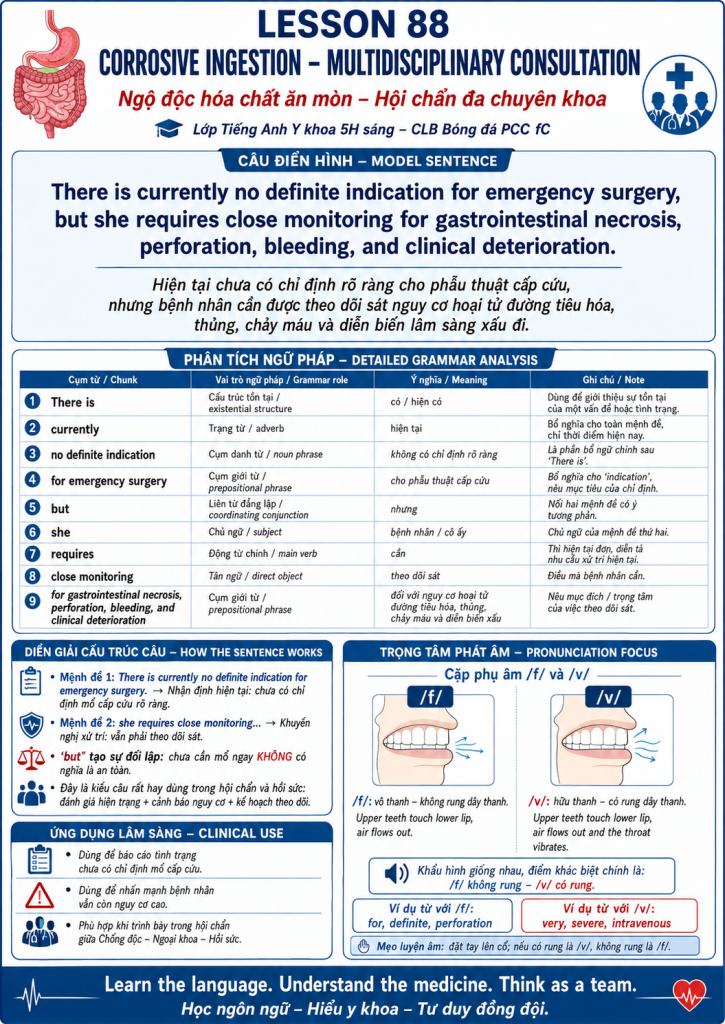
VI. LANGUAGE FOCUS – CÂU ĐIỂN HÌNH
Câu được lựa chọn
“Our priority is not to delay surgery unnecessarily, but to rapidly correct reversible abnormalities that could substantially increase perioperative risk.”
1. Chủ ngữ
Our priority
- Our: tính từ sở hữu.
- priority: danh từ trung tâm.
- Nghĩa: Ưu tiên của chúng ta.
2. Cấu trúc đối lập
is not to delay…, but to correct…
Đây là cấu trúc:
not A, but B
Trong câu này:
- not to delay surgery unnecessarily
- but to rapidly correct reversible abnormalities
Hai thành phần sử dụng song song to-infinitive, tạo nên parallel structure.
Ý nghĩa
Không phải A, mà là B.
Đây là cách diễn đạt rất thường gặp khi bác sĩ muốn điều chỉnh cách nhìn hoặc xác định lại ưu tiên lâm sàng.
Ví dụ:
The goal is not to normalize the creatinine, but to identify and treat the underlying cause.
Mục tiêu không phải là đưa creatinine về bình thường, mà là xác định và xử trí nguyên nhân nền.
3. Trạng từ
unnecessarily
Bổ nghĩa cho:
delay surgery
Nghĩa là:
trì hoãn phẫu thuật một cách không cần thiết
4. Cụm động từ
rapidly correct
- rapidly: trạng từ
- correct: động từ
→ nhanh chóng điều chỉnh
5. Cụm danh từ
reversible abnormalities
- reversible = có thể đảo ngược/hồi phục
- abnormalities = các bất thường
Trong y học hồi sức, việc phân biệt:
reversible vs irreversible causes
là một nguyên tắc rất quan trọng.
6. Mệnh đề quan hệ
that could substantially increase perioperative risk
that thay thế cho:
reversible abnormalities
Cấu trúc:
that + modal verb + adverb + verb + object
- could → có thể
- substantially → đáng kể
- increase → làm tăng
- perioperative risk → nguy cơ chu phẫu
VII. CLINICAL REASONING – TƯ DUY LÂM SÀNG
1. The fracture requires definitive treatment
A displaced femoral neck fracture in an older patient is not simply a painful orthopedic injury. Prolonged immobilization may contribute to:
- venous thromboembolism,
- pneumonia,
- pressure injury,
- delirium,
- functional decline,
- further deconditioning.
Vì vậy, không nên trì hoãn phẫu thuật chỉ để chờ mọi xét nghiệm trở về “đẹp”.
2. Hyperkalemia changes the immediate priority
Severe hyperkalemia may cause:
- conduction abnormalities,
- bradyarrhythmia,
- ventricular arrhythmia,
- cardiac arrest.
Do đó, khi K⁺ khoảng 7 mmol/L, đây là vấn đề cần ưu tiên kiểm soát trước gây mê.
Important principle
Treat the immediate physiological threat first.
Ưu tiên xử trí mối đe dọa sinh lý tức thời.
3. AKI requires etiological reasoning
Không nên chỉ nhìn vào creatinine.
Cần đặt câu hỏi:
Is the AKI caused by:
- hypovolemia?
- sepsis?
- nephrotoxic drugs?
- urinary obstruction?
- cardiorenal congestion?
- or multiple simultaneous factors?
Key sentence
AKI is a syndrome; creatinine is a marker, not the diagnosis itself.
Tổn thương thận cấp là một hội chứng; creatinine là một chỉ dấu chứ không phải bản thân chẩn đoán nguyên nhân.
VIII. THE FLUID PARADOX – NGHỊCH LÝ BÙ DỊCH
Người bệnh có:
- AKI,
- tiền sử suy tim,
- phù hai chân.
Nếu thiếu thể tích thật sự → bù dịch có thể cải thiện tưới máu thận.
Nhưng nếu bệnh nhân đang venous congested → truyền quá nhiều dịch có thể:
- tăng áp lực tĩnh mạch,
- tăng sung huyết thận,
- làm giảm gradient tưới máu thận,
- làm nặng phù,
- làm nặng suy tim.
Vì vậy:
Fluid therapy should be guided by physiology, not by creatinine alone.
Điều trị dịch phải dựa trên sinh lý bệnh của người bệnh, không chỉ dựa vào creatinine.
IX. PERIOPERATIVE DECISION-MAKING
Một cách tiếp cận hợp lý là đánh giá liên tục:
A. Is there an immediately life-threatening abnormality?
Ví dụ:
- severe hyperkalemia,
- unstable arrhythmia,
- shock,
- severe hypoxemia,
- acute decompensated heart failure.
B. Is the abnormality reversible within a clinically meaningful time?
Nếu có → điều chỉnh nhanh.
C. Will additional delay materially improve perioperative safety?
Nếu không → cần cân nhắc tiến tới phẫu thuật.
D. What is the harm of delaying definitive treatment?
Đây là câu hỏi rất quan trọng nhưng đôi khi bị bỏ quên.
X. COMMUNICATION PEARLS – CÁCH NÓI TRONG HỘI CHẨN
Thay vì nói:
“She cannot undergo surgery because her laboratory values are abnormal.”
Nên diễn đạt chuyên nghiệp hơn:
“At present, the major modifiable perioperative risks are hyperkalemia, acute kidney injury, and possible cardiac decompensation. We should correct these promptly and reassess surgical readiness.”
Thay vì:
“We need to wait until everything is normal.”
Nên nói:
“Complete normalization is not necessarily required; what matters is whether the major reversible physiological risks have been adequately controlled.”
XI. MINI SPEAKING PRACTICE
Question 1
Why should this patient not undergo immediate surgery?
Suggested answer:
Because severe hyperkalemia and acute kidney injury may significantly increase anesthetic and perioperative risk and should first be stabilized.
Question 2
Why should surgery not be delayed for too long?
Suggested answer:
Because prolonged immobilization after hip fracture may increase complications and delay functional recovery.
Question 3
Why is fluid management difficult in this patient?
Suggested answer:
Because she may require optimization of renal perfusion while simultaneously being vulnerable to fluid overload and venous congestion due to underlying heart failure.
Question 4
What does preoperative optimization mean?
Suggested answer:
It means identifying and correcting clinically important reversible abnormalities sufficiently to allow definitive treatment to proceed safely and promptly.
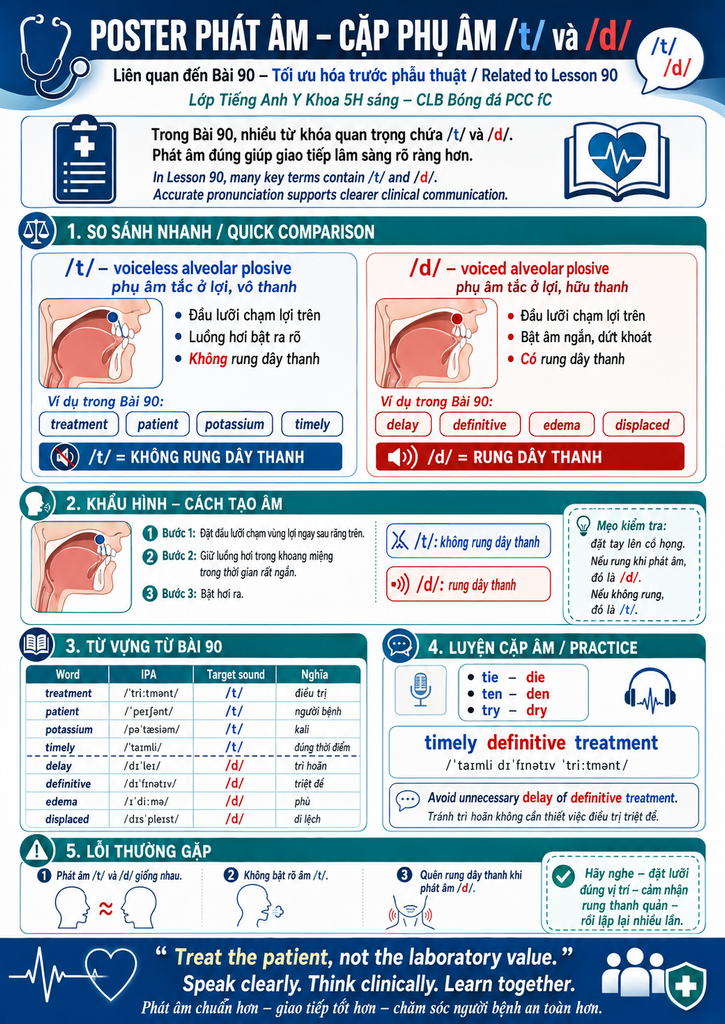
XII. PRONUNCIATION FOCUS – /t/ AND /d/
Hai âm xuất hiện rất nhiều trong bài:
- treatment
- patient
- potassium
- stabilized
- displaced
- guided
/t/ – voiceless alveolar plosive
Ví dụ:
- treatment /ˈtriːtmənt/
- potassium /pəˈtæsiəm/
Đầu lưỡi chạm vùng lợi ngay sau răng trên, luồng khí bị chặn rồi bật ra, không rung dây thanh.
/d/ – voiced alveolar plosive
Ví dụ:
- displaced /dɪsˈpleɪst/
- guided /ˈɡaɪdɪd/
Vị trí lưỡi gần giống /t/, nhưng có rung dây thanh.
Practice
timely definitive treatment
/ˈtaɪmli dɪˈfɪnətɪv ˈtriːtmənt/
Học viên đọc chậm → đọc theo cụm → sau đó đọc với tốc độ giao tiếp tự nhiên.
XIII. TAKE-HOME MESSAGES
1.
Treat the patient, not the laboratory value.
Điều trị người bệnh, không điều trị riêng con số xét nghiệm.
2.
Correct what is dangerous and reversible.
Điều chỉnh những gì nguy hiểm và có thể hồi phục.
3.
Optimization does not mean perfection.
Tối ưu hóa không đồng nghĩa với hoàn hảo.
4.
Avoid unnecessary delay of definitive treatment.
Tránh trì hoãn không cần thiết điều trị triệt để.
5.
Multidisciplinary communication transforms complex decisions into safer care.
Phối hợp đa chuyên khoa giúp biến những quyết định phức tạp thành chăm sóc người bệnh an toàn hơn.
XIV. CÂU THÔNG ĐIỆP CỦA BÀI 90
“Optimization does not mean perfection. It means correcting what is dangerous, identifying what is reversible, and moving forward at the right time.”
Dịch
“Tối ưu hóa không có nghĩa là phải đạt đến sự hoàn hảo. Đó là điều chỉnh những gì nguy hiểm, nhận diện những gì có thể hồi phục và tiến tới điều trị vào đúng thời điểm.”
🌟 PCC fC MEDICAL ENGLISH 5 AM
Learn English – Think Clinically – Communicate Clearly – Work as a Team – Save Lives
Học tiếng Anh – Rèn tư duy lâm sàng – Giao tiếp chuẩn xác – Phối hợp đồng đội – Vì người bệnh.