Bài 154 – Tiếng Anh Y khoa: Tổn thương cơ tim cấp so với nhồi máu cơ tim không ST chênh lên (NSTEMI) * Acute Myocardial Injury versus Non-ST-Elevation Myocardial Infarction (NSTEMI)
PCC Language – Thăng Long, ngày 4/11/2026, Trong thực hành hồi sức cấp cứu, troponin tăng cao không phải lúc nào cũng đồng nghĩa với nhồi máu cơ tim. Đặc biệt ở bệnh nhân cao tuổi có suy hô hấp, suy tim, nhiễm trùng và suy thận, việc phân biệt tổn thương cơ tim cấp, nhồi máu cơ tim type 1 và type 2 đòi hỏi tư duy lâm sàng sâu sắc, khả năng phân tích bằng chứng và phối hợp liên chuyên khoa. Bài học 154 đưa chúng ta đến một cuộc hội chẩn giữa chuyên gia Tim mạch và bác sĩ Hồi sức Cấp cứu về bệnh nhân nữ 97 tuổi có suy hô hấp cấp và troponin tăng đáng kể. Thông qua tám lượt hội thoại chuyên sâu, chúng ta sẽ rèn luyện tiếng Anh y khoa ở trình độ C1–C2, phát triển kỹ năng phản biện chẩn đoán, đánh giá nguy cơ và đưa ra quyết định điều trị cá thể hóa.
In critical care medicine, an elevated troponin level does not necessarily indicate myocardial infarction. Particularly in elderly patients with respiratory failure, heart failure, infection, and renal impairment, distinguishing acute myocardial injury from type 1 and type 2 myocardial infarction requires sophisticated clinical reasoning, critical appraisal of evidence, and effective interdisciplinary collaboration.
In Lesson 154, we will explore a challenging consultation between a senior cardiologist and an intensive care specialist involving a 97-year-old woman with acute respiratory failure and markedly elevated troponin levels. Through eight advanced clinical exchanges, we will strengthen our C1–C2 medical English, refine our diagnostic reasoning, and develop the confidence to communicate complex clinical decisions with precision, professionalism, and compassion.
Today’s message: “Treat the patient, not merely the biomarker.”
Think critically. Communicate clearly. Treat wisely.
PCC fC – One passion for Health, Joy, and Happiness.
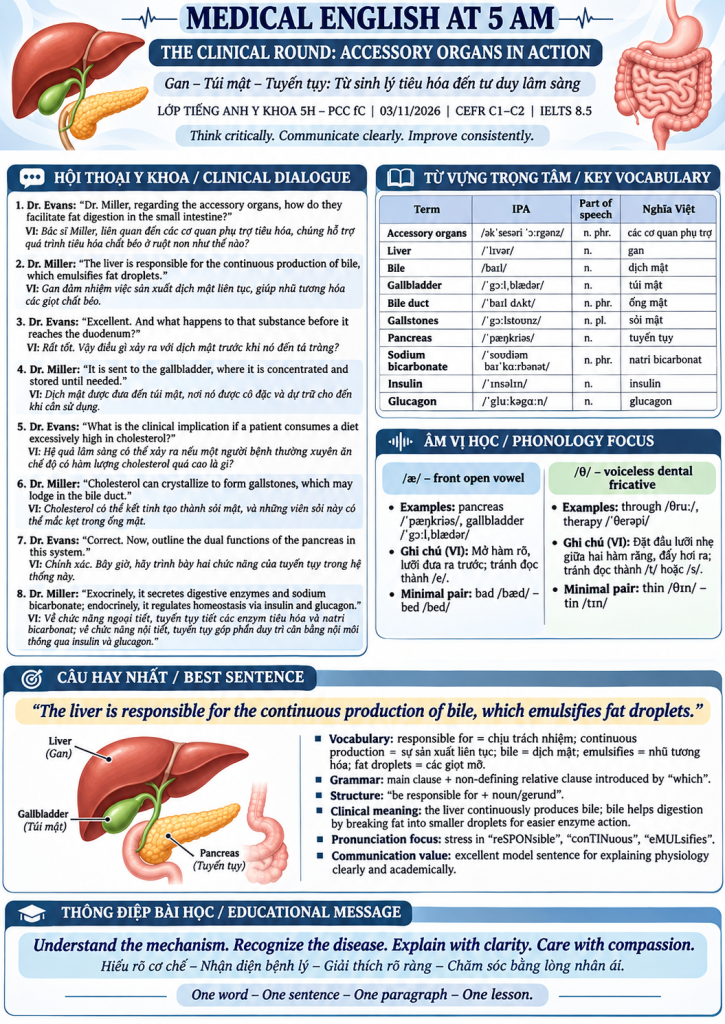
MEDICAL ENGLISH AT 5 AM – LESSON 154
CARDIOLOGY–CRITICAL CARE CONSULTATION
Acute Myocardial Injury versus Non-ST-Elevation Myocardial Infarction (NSTEMI)
LỚP TIẾNG ANH Y KHOA 5H – PCC fC
CEFR C1–C2 | IELTS 8.5 | OET Medicine | AMEE-Informed Medical Education
Ngày học: 04/11/2026
Thời gian: 05:00–05:30 (giờ Việt Nam)
Thông điệp trọng tâm: Treat the patient, not merely the biomarker.
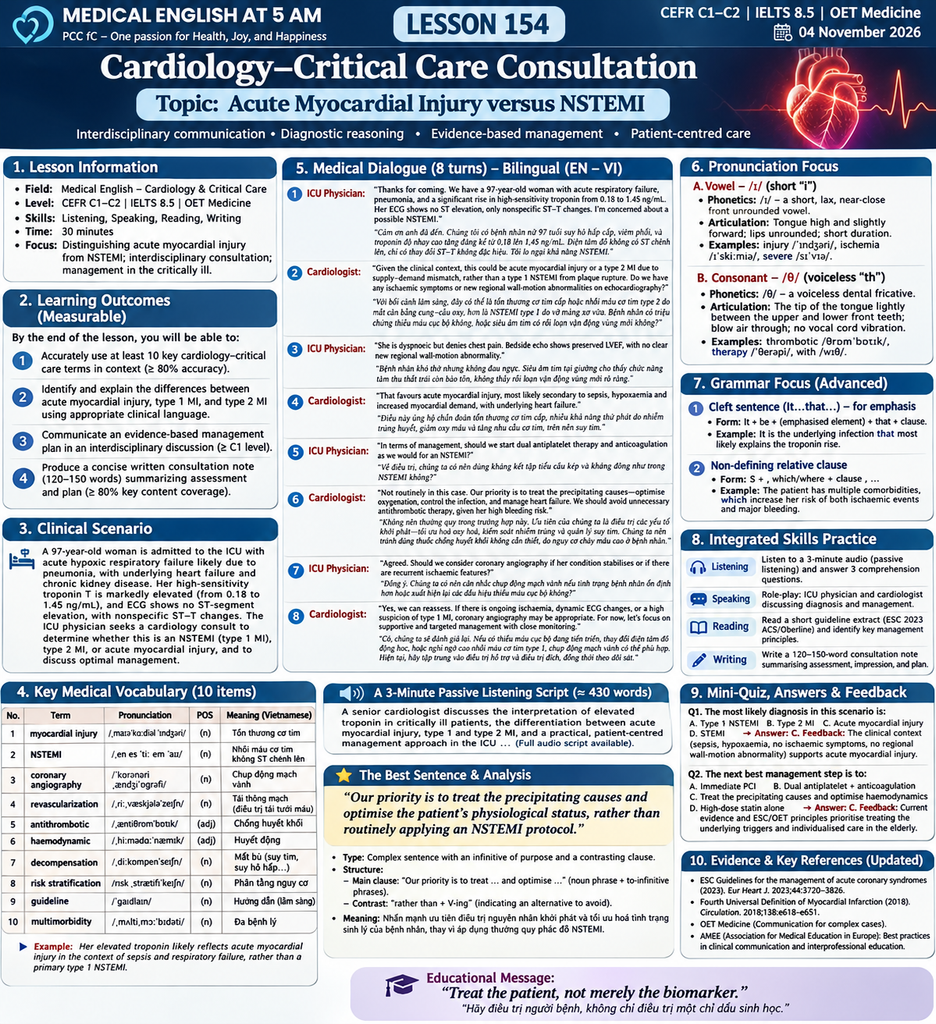
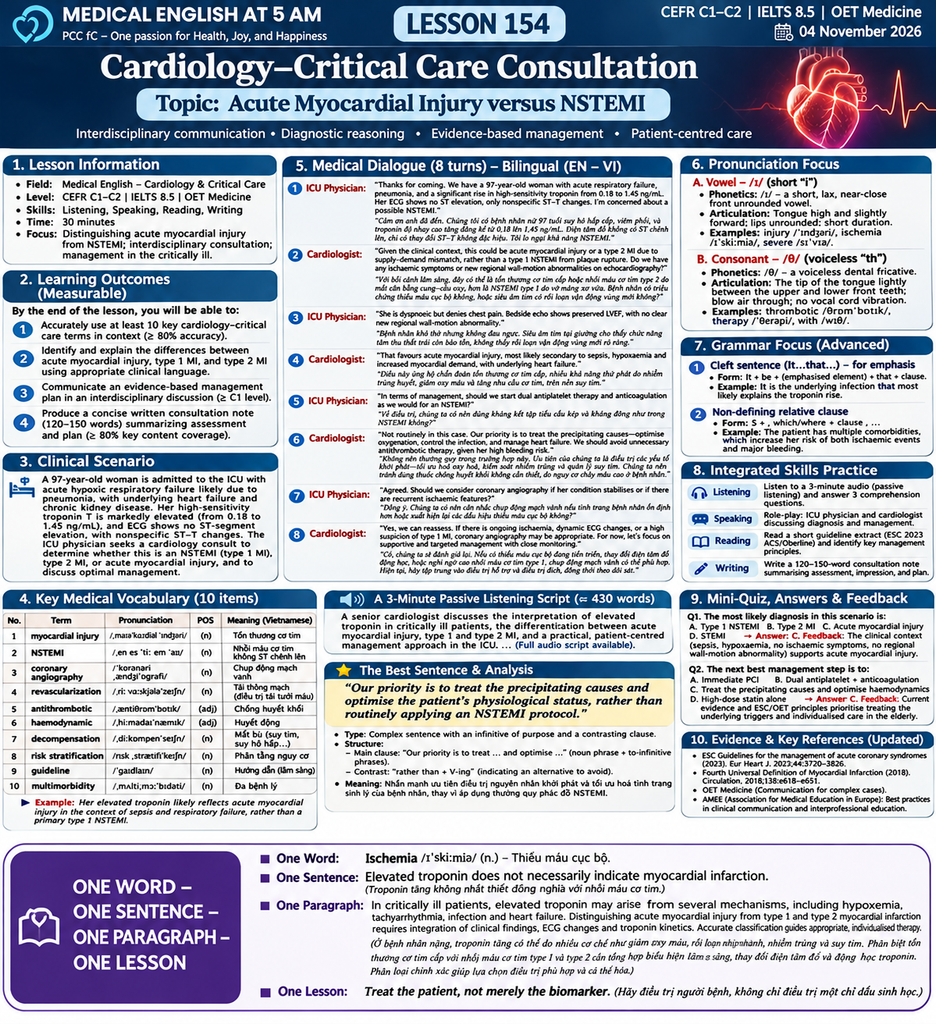
PART 1. LESSON INFORMATION – THÔNG TIN BÀI HỌC
1.1. Chủ đề chuyên môn
Phân biệt tổn thương cơ tim cấp (acute myocardial injury), nhồi máu cơ tim type 1 (type 1 myocardial infarction) và nhồi máu cơ tim type 2 (type 2 myocardial infarction) ở bệnh nhân hồi sức tích cực.
1.2. Bối cảnh
Hội chẩn giữa chuyên gia Tim mạch và bác sĩ Hồi sức Cấp cứu về một bệnh nhân nữ 97 tuổi, suy hô hấp cấp, tăng troponin, nghi nhiễm trùng phổi, suy tim và bệnh thận mạn.
1.3. Định hướng giáo dục
- CEFR C1–C2: Giao tiếp chuyên môn chính xác, linh hoạt và có khả năng lập luận phản biện.
- IELTS 8.5: Phát triển vốn từ học thuật, cấu trúc ngữ pháp phức hợp, tính mạch lạc và khả năng diễn đạt quan điểm có căn cứ.
- OET Medicine: Thực hành trao đổi liên chuyên khoa, làm rõ thông tin, đánh giá nguy cơ và thống nhất kế hoạch chăm sóc.
- AMEE-informed: Áp dụng học tập dựa trên ca bệnh, chuẩn đầu ra đo lường được, thực hành chủ động và phản hồi có cấu trúc.
1.4. Phân bổ 30 phút
| Thời gian | Hoạt động |
|---|---|
| 05:00–05:03 | Giới thiệu và tình huống lâm sàng |
| 05:03–05:08 | 10 từ vựng chuyên môn |
| 05:08–05:15 | Hội thoại song ngữ và đóng vai |
| 05:15–05:19 | Phát âm và hai cấu trúc ngữ pháp |
| 05:19–05:25 | Luyện nghe, nói, đọc, viết |
| 05:25–05:29 | Kiểm tra và phản hồi |
| 05:29–05:30 | Tổng kết và thông điệp giáo dục |
Bài nghe thụ động 3 phút được sử dụng trước hoặc sau buổi học để củng cố kiến thức, không làm tăng thời lượng học trực tiếp.
PART 2. LEARNING OUTCOMES – CHUẨN ĐẦU RA
Sau bài học, học viên có thể:
LO1 – Medical Vocabulary
Nhận diện và sử dụng chính xác ít nhất 8/10 thuật ngữ tim mạch – hồi sức trong ngữ cảnh lâm sàng.
LO2 – Clinical Reasoning
Giải thích bằng tiếng Anh trong 45–60 giây sự khác biệt giữa acute myocardial injury, type 1 MI và type 2 MI, nêu đúng các tiêu chí chẩn đoán cốt lõi.
LO3 – Professional Communication
Thực hiện hội thoại hội chẩn 8 lượt với mức độ chính xác nội dung ít nhất 80%, sử dụng ngôn ngữ chuyên nghiệp và cách diễn đạt phù hợp với mức độ chắc chắn của bằng chứng.
LO4 – Pronunciation and Grammar
Phát âm đúng trọng âm của ít nhất 4/5 thuật ngữ được kiểm tra và vận dụng được hai cấu trúc ngữ pháp nâng cao vào tình huống mới.
LO5 – Clinical Decision-Making
Đề xuất bằng tiếng Anh ít nhất ba ưu tiên đánh giá hoặc xử trí, đồng thời giải thích một nguy cơ của điều trị chống huyết khối ở người bệnh rất cao tuổi.
PART 3. CLINICAL SCENARIO – TÌNH HUỐNG LÂM SÀNG
3.1. Case presentation
English
A 97-year-old woman with a history of heart failure, chronic obstructive pulmonary disease, hypertension, and chronic kidney disease was admitted with acute respiratory failure.
She initially presented with profound hypoxemia, with an oxygen saturation of approximately 84%, requiring endotracheal intubation and invasive mechanical ventilation.
Her heart rate was approximately 140 beats per minute, with a suspected tachyarrhythmia. Serial troponin measurements showed a substantial increase. NT-proBNP was markedly elevated, while chest imaging demonstrated bilateral pulmonary opacities, pleural effusions, and cardiomegaly.
Echocardiography reportedly showed no regional wall-motion abnormalities.
The principal diagnostic challenge was to distinguish acute myocardial injury from type 1 or type 2 myocardial infarction while identifying the predominant cause of respiratory failure.
3.2. Bản dịch tiếng Việt
Bệnh nhân nữ 97 tuổi, có tiền sử suy tim, bệnh phổi tắc nghẽn mạn tính, tăng huyết áp và bệnh thận mạn, nhập viện vì suy hô hấp cấp.
Ban đầu, bệnh nhân có tình trạng giảm oxy máu nghiêm trọng, SpO₂ khoảng 84%, cần đặt nội khí quản và thở máy xâm nhập.
Tần số tim khoảng 140 lần/phút, nghi rối loạn nhịp nhanh. Troponin tăng đáng kể qua các lần xét nghiệm. NT-proBNP tăng rất cao, trong khi hình ảnh lồng ngực ghi nhận các đám mờ nhu mô phổi hai bên, tràn dịch màng phổi và tim to.
Siêu âm tim được báo cáo không ghi nhận bất thường vận động vùng.
Thách thức chẩn đoán chính là phân biệt tổn thương cơ tim cấp với nhồi máu cơ tim type 1 hoặc type 2, đồng thời xác định nguyên nhân chủ đạo gây suy hô hấp.
3.3. Clinical reasoning questions
Question 1: Does elevated troponin necessarily indicate myocardial infarction?
Troponin tăng có nhất thiết đồng nghĩa với nhồi máu cơ tim không?
Question 2: What evidence is required to distinguish type 2 myocardial infarction from acute non-ischemic myocardial injury?
Cần bằng chứng nào để phân biệt nhồi máu cơ tim type 2 với tổn thương cơ tim cấp không do thiếu máu?
Question 3: How should the patient’s age, renal impairment, and bleeding risk influence management?
Tuổi, suy giảm chức năng thận và nguy cơ xuất huyết ảnh hưởng như thế nào đến chiến lược điều trị?
Clinical reminder: An elevated troponin concentration is a finding, not a complete diagnosis.
PART 4. ADVANCED MEDICAL VOCABULARY – 10 TỪ VỰNG CHUYÊN MÔN
Phiên âm IPA tham khảo giọng Anh-Mỹ.
1. Myocardial injury /ˌmaɪəˈkɑːrdiəl ˈɪndʒəri/
- Part of speech: Noun phrase (n. phr.)
- Nghĩa: Tổn thương cơ tim.
- Example: The rising troponin concentration indicates acute myocardial injury.
- Dịch: Nồng độ troponin tăng theo thời gian cho thấy tổn thương cơ tim cấp.
2. Ischemia /ɪˈskiːmiə/
- Part of speech: Noun (n.)
- Nghĩa: Thiếu máu cục bộ.
- Example: Myocardial infarction requires evidence of acute myocardial ischemia.
- Dịch: Nhồi máu cơ tim đòi hỏi bằng chứng thiếu máu cơ tim cấp.
3. Hypoxemia /ˌhaɪpɑːkˈsiːmiə/
- Part of speech: Noun (n.)
- Nghĩa: Giảm oxy máu.
- Example: Severe hypoxemia may contribute to myocardial oxygen supply–demand imbalance.
- Dịch: Giảm oxy máu nặng có thể góp phần gây mất cân bằng cung–cầu oxy cơ tim.
4. Tachyarrhythmia /ˌtækiəˈrɪðmiə/
- Part of speech: Noun (n.)
- Nghĩa: Rối loạn nhịp nhanh.
- Example: A sustained tachyarrhythmia can increase myocardial oxygen demand.
- Dịch: Rối loạn nhịp nhanh kéo dài có thể làm tăng nhu cầu oxy cơ tim.
5. Precipitate /prɪˈsɪpɪteɪt/
- Part of speech: Verb (v.)
- Nghĩa: Thúc đẩy, gây khởi phát.
- Example: Acute infection may precipitate cardiovascular decompensation.
- Dịch: Nhiễm trùng cấp có thể thúc đẩy tình trạng mất bù tim mạch.
6. Scrutinize /ˈskruːtənaɪz/
- Part of speech: Verb (v.)
- Nghĩa: Xem xét, phân tích kỹ lưỡng.
- Example: We must scrutinize serial electrocardiograms before establishing the diagnosis.
- Dịch: Chúng ta phải phân tích kỹ các điện tâm đồ theo thời gian trước khi xác lập chẩn đoán.
7. Troponin kinetics /ˈtroʊpənɪn kɪˈnetɪks/
- Part of speech: Noun phrase (n. phr.)
- Nghĩa: Động học troponin.
- Example: Troponin kinetics help distinguish acute from chronic myocardial injury.
- Dịch: Động học troponin giúp phân biệt tổn thương cơ tim cấp với tổn thương cơ tim mạn tính.
8. Antithrombotic /ˌæntiθrɑːmˈbɑːtɪk/
- Part of speech: Adjective (adj.)
- Nghĩa: Thuộc liệu pháp chống huyết khối.
- Example: Antithrombotic treatment requires careful assessment of bleeding risk.
- Dịch: Điều trị chống huyết khối đòi hỏi đánh giá cẩn thận nguy cơ xuất huyết.
9. Frailty /ˈfreɪlti/
- Part of speech: Noun (n.)
- Nghĩa: Tình trạng suy yếu, giảm dự trữ sinh lý.
- Example: Frailty should be considered when planning invasive cardiac procedures.
- Dịch: Cần xem xét tình trạng suy yếu khi lập kế hoạch can thiệp tim mạch xâm lấn.
10. Individualize /ˌɪndɪˈvɪdʒuəlaɪz/
- Part of speech: Verb (v.)
- Nghĩa: Cá thể hóa.
- Example: Clinicians should individualize treatment according to the patient’s risks and goals of care.
- Dịch: Bác sĩ cần cá thể hóa điều trị dựa trên nguy cơ và mục tiêu chăm sóc của người bệnh.
Vocabulary challenge: Use at least five of these terms to deliver a 45-second clinical summary.
PART 5. CLINICAL DIALOGUE – HỘI THOẠI Y KHOA SONG NGỮ
Characters:
Dr. Anderson – Senior Cardiologist (Chuyên gia Tim mạch).
Dr. Miller – Intensive Care Specialist (Bác sĩ Hồi sức Cấp cứu).
1. Dr. Miller – Clinical Presentation
English:
Our 97-year-old patient presented with profound hypoxemia, acute respiratory failure, and a substantial rise in troponin. Given her underlying heart failure and chronic kidney disease, how should we interpret these findings?
Tiếng Việt:
Bệnh nhân 97 tuổi của chúng tôi nhập viện với tình trạng giảm oxy máu nghiêm trọng, suy hô hấp cấp và troponin tăng đáng kể. Với bệnh nền suy tim và bệnh thận mạn, chúng ta nên diễn giải những dấu hiệu này như thế nào?
2. Dr. Anderson – Diagnostic Criteria
English:
The dynamic elevation in troponin indicates acute myocardial injury; however, diagnosing myocardial infarction requires additional evidence of acute ischemia, rather than relying solely on biomarker abnormalities.
Tiếng Việt:
Sự gia tăng troponin theo thời gian cho thấy tổn thương cơ tim cấp; tuy nhiên, chẩn đoán nhồi máu cơ tim đòi hỏi thêm bằng chứng thiếu máu cơ tim cấp, thay vì chỉ dựa vào bất thường của các dấu ấn sinh học.
3. Dr. Miller – Differential Diagnosis
English:
Considering her severe hypoxemia, suspected rapid atrial fibrillation, systemic inflammation, and possible acute heart failure, could myocardial oxygen supply–demand imbalance explain the troponin elevation?
Tiếng Việt:
Xét đến tình trạng giảm oxy máu nặng, nghi rung nhĩ đáp ứng thất nhanh, phản ứng viêm toàn thân và khả năng suy tim cấp, liệu sự mất cân bằng cung–cầu oxy cơ tim có thể giải thích tình trạng tăng troponin hay không?
4. Dr. Anderson – Pathophysiological Interpretation
English:
Indeed. These physiological stressors may precipitate type 2 myocardial infarction if acute ischemia is demonstrated; in its absence, acute non-ischemic myocardial injury remains a more defensible diagnosis.
Tiếng Việt:
Đúng vậy. Những yếu tố gây stress sinh lý này có thể thúc đẩy nhồi máu cơ tim type 2 nếu chứng minh được thiếu máu cơ tim cấp; khi chưa có bằng chứng đó, tổn thương cơ tim cấp không do thiếu máu cục bộ vẫn là chẩn đoán có cơ sở hơn.
5. Dr. Miller – Critical Appraisal
English:
Nevertheless, since elderly patients frequently exhibit atypical presentations, can we safely exclude type 1 myocardial infarction merely because she reported no chest pain and had no regional wall-motion abnormalities?
Tiếng Việt:
Tuy nhiên, vì bệnh nhân cao tuổi thường có biểu hiện không điển hình, liệu chúng ta có thể loại trừ an toàn nhồi máu cơ tim type 1 chỉ vì bệnh nhân không đau ngực và không có bất thường vận động vùng trên siêu âm tim hay không?
6. Dr. Anderson – Evidence-Based Reasoning
English:
Certainly not. We must scrutinize serial electrocardiograms, troponin kinetics, and echocardiographic findings while assessing whether further coronary investigation would meaningfully influence management.
Tiếng Việt:
Chắc chắn là không. Chúng ta phải phân tích kỹ điện tâm đồ theo thời gian, động học troponin và kết quả siêu âm tim, đồng thời đánh giá liệu thăm dò động mạch vành bổ sung có thực sự làm thay đổi chiến lược điều trị hay không.
7. Dr. Miller – Therapeutic Decision-Making
English:
Given her extreme age, renal impairment, and potentially substantial bleeding risk, how should we reconcile the benefits of antithrombotic therapy with the need to stabilize her respiratory and hemodynamic status?
Tiếng Việt:
Với tuổi rất cao, chức năng thận suy giảm và nguy cơ xuất huyết có thể đáng kể, chúng ta nên cân bằng lợi ích của liệu pháp chống huyết khối với nhu cầu ổn định tình trạng hô hấp và huyết động như thế nào?
8. Dr. Anderson – Clinical Conclusion
English:
Our immediate priorities are to optimize oxygenation, address infection and cardiac dysfunction, and clarify the mechanism of myocardial injury. Antithrombotic and invasive strategies should then be individualized according to ischemic probability, bleeding risk, frailty, and the patient’s goals of care.
Tiếng Việt:
Các ưu tiên trước mắt là tối ưu hóa oxy hóa máu, xử trí nhiễm trùng và rối loạn chức năng tim, đồng thời làm rõ cơ chế tổn thương cơ tim. Sau đó, chiến lược chống huyết khối và can thiệp xâm lấn cần được cá thể hóa dựa trên khả năng thiếu máu cơ tim, nguy cơ xuất huyết, mức độ suy yếu và mục tiêu chăm sóc của người bệnh.
Role-play instructions:
Round 1: Read the dialogue with the script.
Round 2: Switch roles and repeat without looking at the Vietnamese translation.
Round 3: Summarize the clinical conclusion in 30 seconds using your own words.
PART 6. PRONUNCIATION FOCUS – PHÁT ÂM TRỌNG TÂM
6.1. Vowel sound: /iː/ – Long close front unrounded vowel
Đặc điểm: Nguyên âm dài, phía trước, vị trí lưỡi cao, môi không tròn.
Examples:
- Ischemia /ɪˈskiːmiə/
- Severe /sɪˈvɪr/ (âm /iː/ không xuất hiện trong cách phát âm Anh-Mỹ này; dùng để so sánh âm /ɪ/)
- Need /niːd/
- Bleeding /ˈbliːdɪŋ/
Minimal pair:
- Sheep /ʃiːp/ – Ship /ʃɪp/
- Beat /biːt/ – Bit /bɪt/
Practice sentence:
“We need to assess the evidence of ischemia.”
Yêu cầu: Phân biệt rõ /iː/ và /ɪ/, tránh đọc hai âm giống nhau.
6.2. Consonant sound: /θ/ – Voiceless dental fricative
Đặc điểm: Phụ âm xát răng, vô thanh.
Examples:
- Thrombosis /θrɑːmˈboʊsɪs/
- Therapy /ˈθerəpi/
- Thorough /ˈθɜːroʊ/
- Pathophysiology /ˌpæθoʊˌfɪziˈɑːlədʒi/
Minimal pair:
- Thin /θɪn/ – Tin /tɪn/
- Thought /θɔːt/ – Taught /tɔːt/
Practice sentence:
“Antithrombotic therapy requires thorough risk assessment.”
Yêu cầu: Đặt đầu lưỡi nhẹ giữa hai hàm răng, tạo luồng khí xát, không thay /θ/ bằng /t/.
6.3. Word stress – Trọng âm
- Is-CHE-mi-a
- Hy-pox-E-mi-a
- SCRU-ti-nize
- Pre-CIP-i-tate
- In-di-VID-u-al-ize
Pronunciation challenge:
“Severe hypoxemia may precipitate myocardial ischemia.”
Đọc ba lần: chậm – tốc độ tự nhiên – tốc độ hội chẩn.
PART 7. ADVANCED GRAMMAR – HAI CẤU TRÚC NGỮ PHÁP C1–C2
Structure 1. Concession and Contrast – Nhượng bộ và đối lập
Original sentence:
“The dynamic elevation in troponin indicates acute myocardial injury; however, diagnosing myocardial infarction requires additional evidence of acute ischemia.”
Phân tích:
- Clause 1: The dynamic elevation in troponin indicates acute myocardial injury.
- Linking adverb: However.
- Clause 2: Diagnosing myocardial infarction requires additional evidence of acute ischemia.
Chức năng:
Dùng để công nhận một bằng chứng nhưng nhấn mạnh giới hạn của bằng chứng đó.
Alternative structures:
“Although troponin is elevated, myocardial infarction cannot be established without evidence of acute ischemia.”
“Despite the elevated troponin concentration, the diagnosis of myocardial infarction remains uncertain.”
Ứng dụng IELTS/OET:
Diễn đạt quan điểm cân bằng, tránh kết luận quá mức khi dữ liệu chưa đầy đủ.
Practice:
Rewrite:
“Troponin is elevated. There is no conclusive evidence of acute ischemia.”
Suggested answer:
“Although troponin is elevated, there is no conclusive evidence of acute ischemia.”
Structure 2. Conditional Clinical Reasoning – Lập luận điều kiện
Original sentence:
“These physiological stressors may precipitate type 2 myocardial infarction if acute ischemia is demonstrated.”
Cấu trúc:
Main clause + if + present simple passive.
- Main clause: These physiological stressors may precipitate type 2 myocardial infarction.
- Conditional clause: If acute ischemia is demonstrated.
Điểm nâng cao:
- “May” thể hiện khả năng, không khẳng định chắc chắn.
- “If” xác định điều kiện cần kiểm chứng.
- “Is demonstrated” là thể bị động, nhấn mạnh bằng chứng.
Clinical application:
“If acute coronary thrombosis is strongly suspected, an urgent cardiology assessment is warranted.”
“If no evidence of acute ischemia emerges, we should reconsider the diagnosis of myocardial infarction.”
Practice:
Complete:
“If serial ECGs demonstrate new ischemic changes, we should ______.”
Suggested answer:
“If serial ECGs demonstrate new ischemic changes, we should reassess the likelihood of acute coronary syndrome and the need for further coronary investigation.”
PART 8. INTEGRATED SKILLS – LISTENING, SPEAKING, READING AND WRITING
8.1. LISTENING – Nghe chủ động
Thời gian: 2 phút.
Giáo viên đọc các lượt thoại 2, 4, 6 và 8 ở tốc độ tự nhiên.
Học viên trả lời:
- What additional evidence is required to diagnose myocardial infarction?
- Which physiological stressors may contribute to myocardial injury?
- Why should antithrombotic treatment be individualized?
Expected answers:
- Evidence of acute myocardial ischemia.
- Hypoxemia, tachyarrhythmia, systemic inflammation, and cardiac dysfunction.
- Because ischemic probability, bleeding risk, frailty, and goals of care vary between patients.
8.2. SPEAKING – Hội chẩn chuyên khoa
Thời gian: 2 phút.
Work in pairs.
Student A: Cardiologist.
Student B: Intensive Care Specialist.
Task:
Discuss whether the patient has type 1 MI, type 2 MI, or acute non-ischemic myocardial injury.
Useful expressions:
- “The available evidence suggests that…”
- “We cannot conclusively establish…”
- “An alternative explanation would be…”
- “I would prioritize…”
- “The benefits must be weighed against…”
Speaking assessment:
- Clinical accuracy: 40%.
- Fluency and coherence: 25%.
- Medical vocabulary: 20%.
- Pronunciation: 15%.
8.3. READING – Đọc hiểu chuyên môn
Thời gian: 1 phút.
Reading passage:
“Acute myocardial injury is characterized by elevated cardiac troponin with a rise and/or fall in serial measurements. Myocardial infarction requires additional evidence of acute myocardial ischemia. In critically ill patients, hypoxemia, tachyarrhythmias, infection, and heart failure may contribute to myocardial injury. Accurate classification is essential because the appropriate management strategy depends on the underlying mechanism.”
Comprehension questions:
- What distinguishes acute from chronic myocardial injury?
- What additional evidence is required for myocardial infarction?
Answers:
- A rise and/or fall in troponin.
- Evidence of acute myocardial ischemia.
8.4. WRITING – Viết nhận định hội chẩn
Thời gian: 1 phút.
Task:
Write a 40–50-word clinical assessment using at least three advanced medical terms.
Model answer:
“The patient demonstrates acute myocardial injury in the setting of profound hypoxemia, suspected tachyarrhythmia, and possible cardiac decompensation. Although type 2 myocardial infarction is plausible, additional evidence of acute ischemia is required. Management should prioritize physiological stabilization while reassessing coronary risk and bleeding complications.”
8.5. PASSIVE LISTENING – BÀI NGHE THỤ ĐỘNG 3 PHÚT
Title: Beyond Troponin – Thinking Critically in Cardiac Emergencies
Instructions: Listen at a comfortable pace. Focus on meaning, pronunciation, and clinical reasoning. The script is designed for approximately three minutes at a slow educational speaking pace, with short pauses.
Full English Script:
Good morning, everyone.
Welcome to Medical English at 5 AM.
Today, we will explore an essential principle in modern cardiovascular and critical care medicine: an elevated troponin level does not necessarily mean that a patient has experienced a myocardial infarction.
Imagine a ninety-seven-year-old woman admitted to the intensive care unit with severe respiratory failure.
She has a history of heart failure, chronic obstructive pulmonary disease, hypertension, and chronic kidney disease.
Her oxygen saturation is dangerously low. Her heart rate is elevated. Blood tests reveal a substantial increase in cardiac troponin.
What should we think?
Our first responsibility is to recognize that troponin is a marker of myocardial injury.
A rise or fall in troponin indicates that the injury may be acute.
However, myocardial infarction requires more than an abnormal biomarker.
We must also identify evidence of acute myocardial ischemia.
This distinction is particularly important in critically ill patients.
Severe hypoxemia can reduce oxygen delivery to the myocardium.
Tachyarrhythmias can increase myocardial oxygen demand.
Infection, inflammation, and acute heart failure may further compromise cardiovascular function.
Together, these physiological stressors may contribute to myocardial injury.
If acute ischemia is demonstrated and the mechanism involves an imbalance between myocardial oxygen supply and demand, type two myocardial infarction may be diagnosed.
However, without evidence of acute ischemia, acute myocardial injury may be the more appropriate classification.
We must also remember that type one myocardial infarction cannot be excluded simply because an elderly patient has no chest pain.
Older patients may present with atypical symptoms, including breathlessness, fatigue, or altered mental status.
Therefore, careful interpretation of serial electrocardiograms, troponin kinetics, echocardiographic findings, and the overall clinical picture is essential.
Treatment decisions require equal attention.
In a frail elderly patient with renal impairment, antithrombotic therapy may carry substantial bleeding risks.
The clinical team must balance potential benefits against possible complications.
Our immediate priorities are to stabilize oxygenation, assess hemodynamics, address underlying causes, and clarify the mechanism of myocardial injury.
Most importantly, every decision should reflect the patient’s condition, prognosis, and goals of care.
Remember this message:
A laboratory result provides information.
Clinical reasoning gives that information meaning.
And compassionate, evidence-based decision-making transforms knowledge into better patient care.
Think critically.
Diagnose precisely.
Treat wisely.
Thank you for learning with Medical English at 5 AM.
Key listening phrases:
- Acute myocardial injury – Tổn thương cơ tim cấp.
- Evidence of acute ischemia – Bằng chứng thiếu máu cơ tim cấp.
- Oxygen supply–demand imbalance – Mất cân bằng cung–cầu oxy.
- Individualized treatment – Điều trị cá thể hóa.
- Evidence-based decision-making – Ra quyết định dựa trên bằng chứng.
PART 9. ASSESSMENT, ANSWERS AND FEEDBACK – KIỂM TRA, ĐÁP ÁN VÀ PHẢN HỒI
Mini-test: 5 câu – 10 điểm.
Question 1. Multiple Choice (2 points)
Which finding is required to diagnose myocardial infarction in addition to acute myocardial injury?
A. Elevated NT-proBNP.
B. Evidence of acute myocardial ischemia.
C. Chronic kidney disease.
D. Elevated C-reactive protein.
Question 2. Multiple Choice (2 points)
Which statement best describes type 2 myocardial infarction?
A. It always results from acute coronary thrombosis.
B. It occurs whenever troponin is elevated.
C. It involves acute myocardial ischemia caused by an oxygen supply–demand imbalance unrelated to acute coronary atherothrombosis.
D. It can be diagnosed solely from an elevated D-dimer.
Question 3. Vocabulary (2 points)
Translate into Vietnamese:
“Antithrombotic therapy should be individualized according to bleeding risk and clinical context.”
Question 4. Grammar (2 points)
Rewrite using “Although”:
“Troponin is markedly elevated. Acute myocardial infarction has not been conclusively established.”
Question 5. Clinical Reasoning (2 points)
Name two potential contributors to myocardial injury in this patient and explain why type 1 MI cannot yet be excluded.
ANSWER KEY – ĐÁP ÁN
Question 1: B.
Myocardial infarction requires evidence of acute myocardial ischemia in addition to acute myocardial injury.
Question 2: C.
Type 2 MI is associated with an imbalance between myocardial oxygen supply and demand, with evidence of acute ischemia, rather than acute coronary atherothrombosis.
Question 3:
“Liệu pháp chống huyết khối cần được cá thể hóa dựa trên nguy cơ xuất huyết và bối cảnh lâm sàng.”
Question 4:
“Although troponin is markedly elevated, acute myocardial infarction has not been conclusively established.”
Question 5:
Possible contributors include severe hypoxemia, tachyarrhythmia, acute heart failure, and systemic infection or inflammation.
Type 1 MI cannot be excluded because the absence of chest pain or regional wall-motion abnormalities does not reliably rule out acute coronary atherothrombosis.
FEEDBACK – PHẢN HỒI
9–10 points: Excellent
Demonstrates advanced clinical reasoning and accurate professional English.
7–8 points: Very Good
Shows strong understanding; minor improvements in precision or expression are needed.
5–6 points: Developing
Review the distinction between myocardial injury and myocardial infarction.
Below 5 points: Needs Reinforcement
Revisit the diagnostic criteria, vocabulary, and clinical dialogue before repeating the test.
Self-reflection:
“What is one diagnostic assumption I should challenge more carefully in my next clinical consultation?”
Tôi cần xem xét lại giả định chẩn đoán nào một cách thận trọng hơn trong lần hội chẩn tiếp theo?
PART 10. EVIDENCE-BASED MEDICINE – CẬP NHẬT Y KHOA VÀ TÀI LIỆU THAM KHẢO
10.1. Những nguyên tắc chuyên môn cần ghi nhớ
Principle 1 – Myocardial injury is not synonymous with myocardial infarction.
Tổn thương cơ tim được xác định khi troponin vượt bách phân vị 99 của giới hạn tham chiếu; sự tăng hoặc giảm theo thời gian xác định tính cấp tính. Nhồi máu cơ tim còn cần bằng chứng thiếu máu cơ tim cấp. JACC+1
Principle 2 – Type 2 MI requires evidence of ischemia.
Nhồi máu cơ tim type 2 xảy ra do mất cân bằng cung–cầu oxy cơ tim, không phải do huyết khối xơ vữa động mạch vành cấp. Không thể chẩn đoán type 2 MI chỉ vì bệnh nhân có thiếu oxy máu, nhịp nhanh và tăng troponin. Oxford Academic+1
Principle 3 – Management must reflect the underlying mechanism.
Theo ESC 2023, xử trí type 2 MI và tổn thương cơ tim cần tập trung vào bệnh lý thúc đẩy, đánh giá tim mạch phù hợp và kiểm soát yếu tố nguy cơ. Không mặc nhiên sử dụng chiến lược chống huyết khối của type 1 MI cho mọi trường hợp tăng troponin. Oxford Academic+1
10.2. Tài liệu tham khảo chính
- Thygesen K, et al. Fourth Universal Definition of Myocardial Infarction (2018). European Heart Journal, 2019. Đọc tài liệu
- European Society of Cardiology. 2023 ESC Guidelines for the Management of Acute Coronary Syndromes. Đọc hướng dẫn
- AMEE – Association for Medical Education in Europe: Khung tham khảo về đào tạo y khoa dựa trên chuẩn đầu ra, học tập chủ động và phản hồi.
- OET Medicine: Khung tham khảo về giao tiếp chuyên nghiệp, độ rõ ràng, sự phù hợp của ngôn ngữ và hiệu quả trao đổi thông tin lâm sàng.
Bài giảng được xây dựng theo định hướng AMEE và OET Medicine, không phải tài liệu được các tổ chức này chứng nhận. Nội dung chuyên môn được đối chiếu với các tài liệu tim mạch nêu trên; chưa khẳng định đã rà soát toàn bộ công bố đến ngày 04/11/2026.
FINAL EDUCATIONAL MESSAGE – THÔNG ĐIỆP GIÁO DỤC
ONE WORD – ONE SENTENCE – ONE PARAGRAPH – ONE LESSON
One word expands our vocabulary.
One sentence strengthens our communication.
One paragraph develops our clinical reasoning.
One lesson transforms knowledge into better patient care.
Một từ mở rộng vốn từ. Một câu nâng cao giao tiếp. Một đoạn phát triển tư duy lâm sàng. Một bài học chuyển hóa kiến thức thành chăm sóc người bệnh tốt hơn.
“The best clinicians do not merely recognize abnormalities; they understand their meaning, question their assumptions, and make decisions guided by evidence and compassion.”
Những bác sĩ giỏi nhất không chỉ nhận diện bất thường; họ hiểu ý nghĩa của chúng, biết phản biện những giả định của chính mình và đưa ra quyết định dựa trên bằng chứng cùng lòng nhân ái.
Think critically. Communicate clearly. Improve consistently.
PCC fC – Vì một đam mê Khỏe Vui Hạnh phúc.