Bài tổng ôn tuần 26: Từ tư duy học thuật tới trí tuệ lâm sàng và tập trung sâu!
PCC Language – Thăng Long, Chào mừng các thầy cô và các bạn học viên đến với Bài tổng ôn tuần 26 của Lớp Tiếng Anh Y khoa 5H – PCC fC, nơi chúng ta cùng nhìn lại hành trình học tập đầy ý nghĩa qua sáu bài học, từ Bài 151 đến Bài 156. Tuần này, chúng ta bắt đầu với kỹ năng lập luận trong IELTS Writing Task 2, cân nhắc lợi ích và hạn chế của y tế từ xa; tiếp tục khám phá nhiễm Clostridioides difficile, chức năng gan–túi mật–tuyến tụy, và cách phân biệt tổn thương cơ tim cấp với nhồi máu cơ tim NSTEMI. Hành trình còn mở rộng đến trí thông minh phi thường của bạch tuộc và nghệ thuật tập trung sâu – Deep Work – trong môi trường hồi sức tích cực. Sáu chủ đề tưởng chừng khác biệt nhưng cùng truyền tải một thông điệp: Học để hiểu bản chất, tư duy dựa trên bằng chứng, giao tiếp chính xác, thích nghi linh hoạt và hành động có trách nhiệm. Thông qua 30 từ vựng trọng tâm, sáu cấu trúc ngữ pháp, hội thoại song ngữ, bài nghe ba phút, thực hành bốn kỹ năng và bài kiểm tra tổng hợp, chúng ta không chỉ củng cố tiếng Anh mà còn rèn luyện tư duy phản biện, năng lực học tập suốt đời và khả năng vận dụng kiến thức vào thực tiễn.
Mỗi ngày một bước tiến. Mỗi tuần một hành trình trưởng thành. Hãy cùng học sâu hơn, nghĩ sáng suốt hơn và lan tỏa những giá trị tốt đẹp!
Welcome, teachers and learners, to Weekly Review 26 of Medical English at 5 AM – PCC fC, where we reflect on an inspiring learning journey through six lessons, from Lesson 151 to Lesson 156.
This week, we began by developing academic reasoning through IELTS Writing Task 2, weighing the advantages and disadvantages of telemedicine. We then explored Clostridioides difficile infection, the functions of the liver, gallbladder, and pancreas, and the essential distinction between acute myocardial injury and NSTEMI. Our journey also took us into the extraordinary intelligence of octopuses and the art of deep work in the intensive care unit.
Although these six topics may appear unrelated, they share one powerful message: Understand underlying mechanisms, think critically, interpret evidence carefully, communicate precisely, adapt intelligently, and act responsibly.
Through 30 essential vocabulary items, six advanced grammar structures, bilingual dialogues, a three-minute listening passage, integrated four-skill practice, and a comprehensive quiz, we aim not only to strengthen our English proficiency but also to develop critical thinking, lifelong learning, and the ability to apply knowledge in real-world situations.
One step forward every day. One meaningful journey of growth every week. Let us learn more deeply, think more wisely, and inspire positive change together!
Medical English at 5 AM – PCC fC
One word – One sentence – One paragraph – One lesson.
Think critically. Communicate clearly. Improve consistently.
PCC fC – Vì một đam mê Khỏe Vui Hạnh phúc!
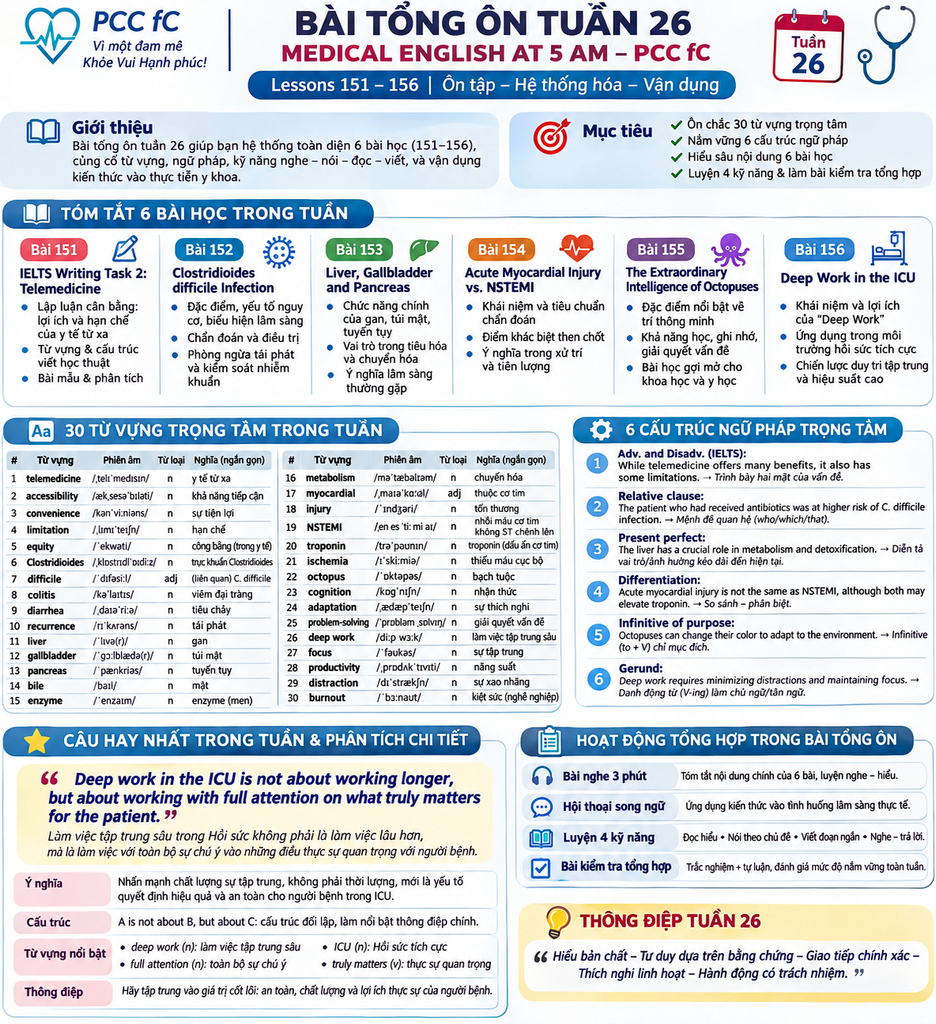
MEDICAL ENGLISH AT 5 AM – WEEKLY REVIEW 26
BÀI TỔNG ÔN TUẦN 26 – TIẾNG ANH Y KHOA 5H
FROM ACADEMIC REASONING TO CLINICAL WISDOM AND DEEP WORK
TỪ TƯ DUY HỌC THUẬT ĐẾN TRÍ TUỆ LÂM SÀNG VÀ TẬP TRUNG SÂU
PCC fC Language | Lớp Tiếng Anh Y khoa 5H – PCC fC
- Thời gian tổng ôn: Thứ Bảy, ngày 07/11/2026.
- Phạm vi: Sáu bài học số 151–156.
- Ngày đăng các bài: 01–06/11/2026.
- Định hướng: CEFR B2–C2 | IELTS 8.0–8.5 | OET Medicine.
- Thời lượng học trực tiếp: 05:00–05:30.
- Hình thức: Tổng ôn tích hợp, thực hành song ngữ, đánh giá kiến thức và tự học.
- Phương pháp: Active Recall – Retrieval Practice – Interleaving – Case-Based Learning – Spaced Repetition.
- Triết lý: Think critically. Communicate clearly. Improve consistently.
PHẦN 1. WEEKLY INTRODUCTION – GIỚI THIỆU TUẦN HỌC
1.1. Giới thiệu bằng tiếng Việt
Trong hành trình học tập của Lớp Tiếng Anh Y khoa 5H – PCC fC, tuần 26 đánh dấu sự kết nối đặc biệt giữa sáu chủ đề: viết luận IELTS, y tế số, nhiễm khuẩn, sinh lý tiêu hóa, tim mạch hồi sức, khoa học thần kinh và phương pháp tập trung sâu.
Bài 151 mở đầu bằng tư duy so sánh lợi ích và hạn chế của khám chữa bệnh từ xa. Qua đó, học viên không chỉ học kỹ thuật viết IELTS Writing Task 2 mà còn biết phân tích đa chiều, nhận diện rủi ro và bảo vệ quan điểm bằng những lập luận có căn cứ.
Bài 152 đưa chúng ta đến với nhiễm Clostridioides difficile, nơi một xét nghiệm dương tính không đồng nghĩa với một chẩn đoán bệnh đang hoạt động.
Bài 153 giúp chúng ta hiểu sự phối hợp giữa gan, túi mật và tuyến tụy, từ đó nhận thức rằng mọi quyết định lâm sàng chính xác đều cần nền tảng sinh lý vững chắc.
Bài 154 tiếp tục nhấn mạnh tư duy chẩn đoán phân biệt: troponin tăng không đồng nghĩa với nhồi máu cơ tim.
Bài 155 mở rộng góc nhìn sang trí thông minh của bạch tuộc và những khám phá về hệ thần kinh phân tán, khả năng học hỏi, thích nghi và giới hạn của hiểu biết khoa học.
Cuối cùng, Bài 156 – Deep Work in the ICU – nhắc nhở chúng ta rằng kiến thức sẽ khó phát huy đầy đủ giá trị nếu thiếu sự tập trung, khả năng ưu tiên và trách nhiệm trong hành động.
Sáu bài học dẫn đến sáu nguyên tắc:
- Biết cân nhắc lợi ích và rủi ro.
- Biết diễn giải bằng chứng trong bối cảnh.
- Hiểu bản chất và cơ chế sinh lý.
- Phân biệt dữ kiện với kết luận chẩn đoán.
- Luôn tò mò, khiêm nhường và thích nghi.
- Tập trung sâu nhưng không đánh đổi an toàn.
Học không chỉ để biết thêm, mà để tư duy tốt hơn, giao tiếp chính xác hơn và hành động có trách nhiệm hơn.
1.2. English Introduction
Good morning, everyone!
Welcome to Weekly Review 26 of Medical English at 5 AM – PCC fC.
This week, we have explored six interconnected lessons covering academic writing, telemedicine, infectious diseases, digestive physiology, cardiovascular medicine, animal intelligence, and deep work.
At first glance, these subjects may appear unrelated. However, they share a powerful educational principle: good decisions require evidence, critical thinking, clear communication, and responsible action.
Our IELTS lesson taught us how to compare advantages and disadvantages and defend a clear position.
Our clinical lessons demonstrated why isolated test results should never replace comprehensive clinical assessment.
Our physiology lesson emphasized the importance of understanding biological mechanisms.
Our exploration of octopus intelligence encouraged curiosity, adaptability, and scientific humility.
Finally, our lesson on deep work challenged us to manage attention, prioritize urgent responsibilities, and improve the quality of our professional performance.
Today, our goal is not simply to memorize six lessons. We aim to connect them, explain them, and apply their principles to real-world situations.
Learn deeply. Think critically. Communicate clearly. Act responsibly.
PHẦN 2. SIX LESSONS – SIX CORE MESSAGES
LESSON 151 – MASTERING IELTS WRITING TASK 2: ADVANTAGES & DISADVANTAGES
Chủ đề: Telemedicine versus Face-to-Face Consultation
Ngày đăng: 01/11/2026
A. Kiến thức trọng tâm
Bài học tập trung vào dạng bài IELTS Writing Task 2:
“Do the advantages outweigh the disadvantages?”
Câu hỏi không chỉ yêu cầu liệt kê lợi ích và hạn chế mà còn đòi hỏi người viết so sánh tầm quan trọng của hai phía, thể hiện quan điểm nhất quán và bảo vệ quan điểm bằng lập luận.
1. Hai dạng đề cần phân biệt
- Advantages and disadvantages: Phân tích lợi ích và hạn chế.
- Do the advantages outweigh the disadvantages?: Đánh giá bên nào quan trọng hơn về tổng thể.
Đối với dạng thứ hai, người viết cần có lập trường rõ ràng, thể hiện xuyên suốt bài.
2. Cấu trúc bài viết bốn đoạn
- Introduction: Giới thiệu vấn đề và quan điểm.
- Body 1: Trình bày mặt hạn chế và phân tích.
- Body 2: Trình bày lợi ích, giải thích vì sao có trọng lượng lớn hơn.
- Conclusion: Khẳng định lại quan điểm.
Đây là một cách tổ chức hiệu quả, không phải cấu trúc bắt buộc duy nhất của IELTS.
3. Phương pháp PEEL
- Point: Nêu luận điểm.
- Explanation: Giải thích.
- Example: Minh họa.
- Link: Liên hệ với lập luận chính.
4. Những lợi ích của Telemedicine
- Cải thiện khả năng tiếp cận dịch vụ y tế cho người dân ở vùng xa.
- Giảm chi phí đi lại và thời gian di chuyển.
- Hỗ trợ quản lý bệnh mạn tính và tái khám phù hợp.
- Tăng khả năng kết nối người bệnh với nhân viên y tế.
- Có tiềm năng giảm một phần nhu cầu khám trực tiếp không cần thiết.
5. Những hạn chế của Telemedicine
- Không thực hiện đầy đủ thăm khám trực tiếp.
- Có nguy cơ bỏ sót dấu hiệu quan trọng.
- Phụ thuộc vào kết nối Internet, thiết bị và năng lực sử dụng công nghệ.
- Có thách thức về bảo mật và quyền riêng tư.
- Không phù hợp để thay thế đánh giá trực tiếp trong nhiều tình trạng cấp cứu hoặc bệnh cảnh phức tạp.
6. Nguyên tắc lập luận khoa học
Không nên khẳng định rằng khám từ xa luôn tốt hơn khám trực tiếp.
Lập luận thuyết phục phải chỉ rõ nhóm người bệnh nào hưởng lợi, trường hợp nào có nguy cơ và điều kiện nào giúp giảm hạn chế.
B. Câu tiếng Anh trọng tâm
“Although telemedicine has certain clinical limitations, its advantages in accessibility and convenience may outweigh these drawbacks when appropriate safeguards are in place.”
Mặc dù khám chữa bệnh từ xa có những hạn chế lâm sàng nhất định, lợi ích về khả năng tiếp cận và sự thuận tiện có thể vượt trội hơn khi có các biện pháp bảo đảm phù hợp.
C. Câu hỏi tư duy
Question: Why must an IELTS outweigh essay present a consistent position?
Suggested answer: Because the task requires the writer to evaluate the relative importance of advantages and disadvantages, rather than merely listing both sides without reaching a reasoned judgment.
Dịch: Bởi vì đề bài yêu cầu người viết đánh giá tầm quan trọng tương đối của lợi ích và hạn chế, thay vì chỉ liệt kê hai mặt mà không đưa ra kết luận có cơ sở.
D. Thông điệp
“A strong argument does not ignore the opposing view; it explains why one position is more convincing.”
Một lập luận mạnh không phớt lờ quan điểm đối lập; nó giải thích vì sao một quan điểm thuyết phục hơn.
Bài học gốc:
LESSON 152 – CLOSTRIDIOIDES DIFFICILE INFECTION
Chủ đề: Nhiễm Clostridioides difficile
Ngày học: 02/11/2026
A. Kiến thức trọng tâm
- Clostridioides difficile là vi khuẩn có khả năng sinh độc tố, gây tiêu chảy và viêm đại tràng.
- Sử dụng kháng sinh, tuổi cao, nằm viện và nhiều yếu tố khác có thể làm tăng nguy cơ CDI.
- Xét nghiệm PCR dương tính không tự chứng minh bệnh do độc tố đang hoạt động.
- Cần phân biệt colonization với active infection.
- Chỉ định xét nghiệm phải phù hợp với triệu chứng và tiêu chuẩn lâm sàng.
- Đánh giá mức độ nặng dựa trên lâm sàng, bạch cầu, chức năng thận và dấu hiệu biến chứng.
- Trong CDI ban đầu không tối cấp, fidaxomicin được ưu tiên theo một số hướng dẫn khi phù hợp và sẵn có; vancomycin uống là lựa chọn thay thế được chấp nhận.
- CDI tối cấp có thể biểu hiện bằng sốc, liệt ruột hoặc phình đại tràng; cần xử trí khẩn cấp.
- Kiểm soát nhiễm khuẩn và quản lý kháng sinh hợp lý đóng vai trò quan trọng.
B. Key Sentence
“A positive molecular test does not necessarily establish active infection.”
Xét nghiệm sinh học phân tử dương tính không nhất thiết xác nhận nhiễm trùng đang hoạt động.
C. Clinical Question
Question: Why is it important to distinguish colonization from active CDI?
Answer: Because detecting a potentially toxigenic microorganism does not necessarily mean that it is responsible for the patient’s symptoms.
D. Take-home Message
“Treat the patient, not merely the laboratory result.”
Điều trị người bệnh, không chỉ điều trị kết quả xét nghiệm.
Bài học gốc:
LESSON 153 – ACCESSORY DIGESTIVE ORGANS
Chủ đề: Gan, túi mật và tuyến tụy
Ngày học: 03/11/2026
A. Kiến thức trọng tâm
- Gan sản xuất dịch mật.
- Túi mật dự trữ và cô đặc dịch mật.
- Muối mật hỗ trợ nhũ tương hóa và hấp thu chất béo.
- Tuyến tụy ngoại tiết tiết enzym tiêu hóa và dịch giàu bicarbonate.
- Tuyến tụy nội tiết tiết các hormon như insulin và glucagon.
- Sỏi đường mật có thể gây tắc nghẽn và biến chứng.
- Sự phối hợp giữa gan, túi mật và tụy rất quan trọng đối với tiêu hóa và chuyển hóa.
- Hiểu cơ chế sinh lý giúp giải thích triệu chứng và định hướng chẩn đoán.
B. Key Sentence
“The liver produces bile, the gallbladder stores and concentrates it, and the pancreas provides digestive enzymes and bicarbonate.”
Gan sản xuất mật, túi mật dự trữ và cô đặc mật, còn tuyến tụy cung cấp enzym tiêu hóa và bicarbonate.
C. Clinical Question
Question: What is the main difference between the exocrine and endocrine pancreas?
Answer: The exocrine pancreas releases digestive secretions into the duodenum, while the endocrine pancreas releases hormones into the bloodstream.
D. Take-home Message
“Understand physiology before interpreting pathology.”
Hiểu sinh lý trước khi diễn giải bệnh lý.
Bài học gốc:
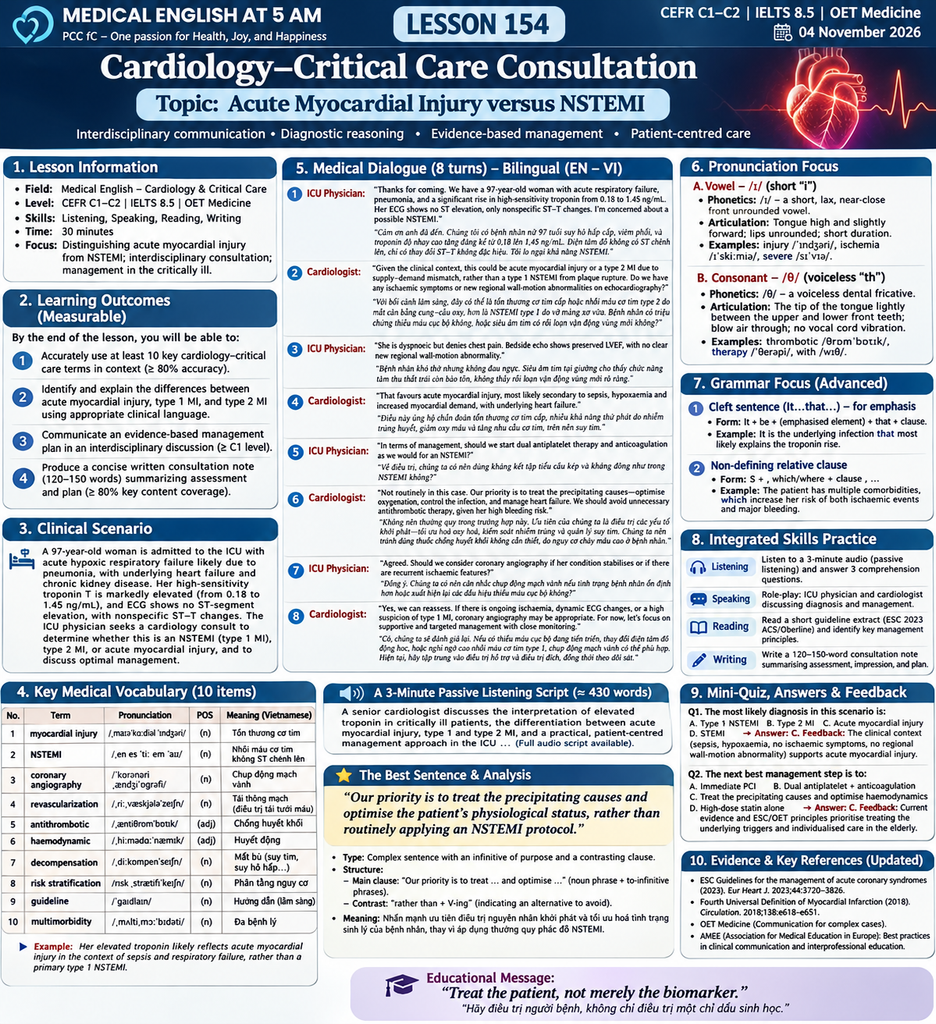
LESSON 154 – ACUTE MYOCARDIAL INJURY VERSUS NSTEMI
Chủ đề: Tổn thương cơ tim cấp và NSTEMI
Ngày học: 04/11/2026
A. Kiến thức trọng tâm
- Troponin tim tăng trên bách phân vị thứ 99 của giới hạn tham chiếu trên là dấu hiệu tổn thương cơ tim.
- Tổn thương cơ tim cấp có biến thiên tăng hoặc giảm troponin.
- Nhồi máu cơ tim đòi hỏi tổn thương cơ tim cấp cùng bằng chứng thiếu máu cơ tim cấp.
- Nhồi máu cơ tim type 1 thường liên quan biến cố xơ vữa động mạch vành cấp.
- Nhồi máu cơ tim type 2 liên quan mất cân bằng cung–cầu oxy cơ tim và có bằng chứng thiếu máu cơ tim.
- Tổn thương cơ tim không do thiếu máu có thể xuất hiện trong nhiều bệnh cảnh cấp và mạn.
- Cần phân tích triệu chứng, ECG, động học troponin, hình ảnh học và diễn biến lâm sàng.
- Điều trị phải dựa trên cơ chế bệnh, không chỉ một kết quả xét nghiệm.
B. Key Sentence
“Elevated troponin indicates myocardial injury, but it does not automatically establish myocardial infarction.”
Troponin tăng chỉ ra tổn thương cơ tim, nhưng không tự động xác lập chẩn đoán nhồi máu cơ tim.
C. Clinical Question
Question: What distinguishes acute myocardial injury from myocardial infarction?
Answer: Acute myocardial injury is identified by elevated cardiac troponin with a rise or fall, whereas myocardial infarction additionally requires evidence of acute myocardial ischemia.
D. Take-home Message
“Interpret the biomarker. Investigate the mechanism. Individualize the treatment.”
Diễn giải dấu ấn sinh học. Tìm hiểu cơ chế. Cá thể hóa điều trị.
Bài học gốc:
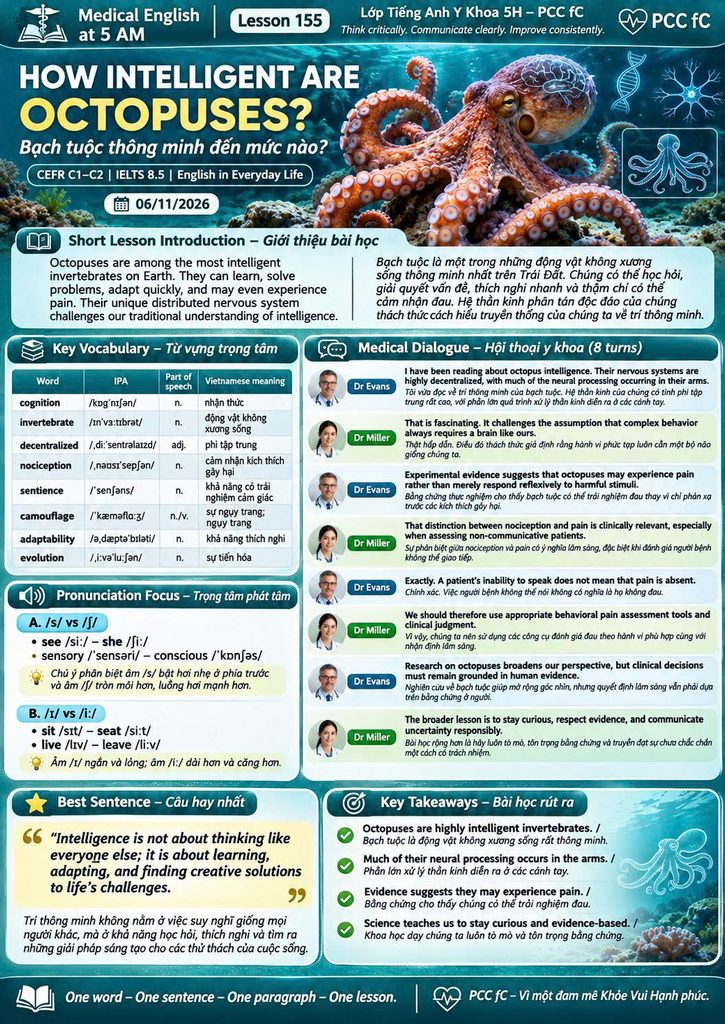
LESSON 155 – THE EXTRAORDINARY INTELLIGENCE OF OCTOPUSES
Chủ đề: Trí thông minh phi thường của bạch tuộc
Ngày học: 05/11/2026
A. Kiến thức trọng tâm
- Bạch tuộc có hệ thần kinh phát triển, với nhiều tế bào thần kinh nằm trong các cánh tay.
- Khả năng xử lý thông tin phân tán góp phần tạo nên sự linh hoạt trong hành vi.
- Bạch tuộc có thể học hỏi, ghi nhớ và giải quyết vấn đề.
- Nociception không đồng nhất với trải nghiệm đau chủ quan.
- Có bằng chứng ủng hộ khả năng bạch tuộc có trải nghiệm đau.
- Bạch tuộc có các trạng thái ngủ yên và ngủ hoạt động.
- Hiện chưa thể khẳng định chắc chắn bạch tuộc thực sự nằm mơ.
- Những khám phá này khuyến khích tư duy khoa học thận trọng và cởi mở.
B. Key Sentence
“Intelligence can evolve along different pathways and does not necessarily resemble human cognition.”
Trí thông minh có thể tiến hóa theo nhiều con đường khác nhau và không nhất thiết giống nhận thức của con người.
C. Scientific Question
Question: Why should scientists remain cautious when discussing octopus dreaming?
Answer: Because active sleep and changes in behavior do not, by themselves, establish the presence of subjective dream experiences.
D. Take-home Message
“Different minds. Different pathways. Endless possibilities.”
Những trí tuệ khác nhau. Những con đường khác nhau. Những khả năng không giới hạn.
Bài học gốc:
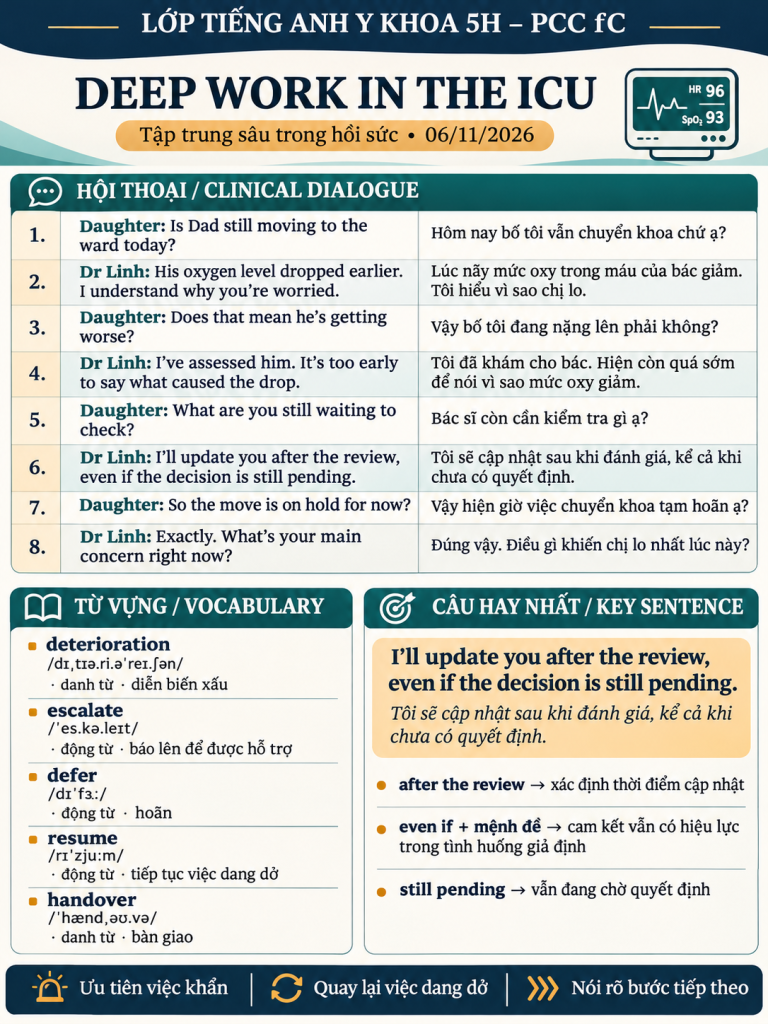
LESSON 156 – DEEP WORK IN THE ICU
Chủ đề: Tập trung sâu trong môi trường hồi sức
Ngày đăng: 06/11/2026; chuyên đề Free Talk ngày 07/11/2026
A. Kiến thức trọng tâm
- Deep Work là phương pháp tập trung có chủ đích vào công việc đòi hỏi nỗ lực nhận thức cao.
- Việc chuyển đổi nhiệm vụ liên tục có thể làm suy giảm hiệu quả nhận thức.
- Attention residue mô tả sự chú ý còn vương lại ở nhiệm vụ trước.
- Cognitive load là tải nhận thức của nhiệm vụ đối với người thực hiện.
- ICU là môi trường có nhiều gián đoạn, trong đó một số gián đoạn là cần thiết để bảo đảm an toàn.
- Cần phân biệt công việc khẩn cấp và không khẩn cấp.
- Khi bị gián đoạn, phải ghi nhận hoặc bàn giao công việc chưa hoàn thành.
- Closed-loop communication giúp xác nhận thông tin và trách nhiệm.
- Deep Work hiệu quả cần đi đôi với ưu tiên lâm sàng, teamwork và patient safety.
B. Key Sentence
“Protect your attention without compromising patient safety.”
Bảo vệ sự tập trung mà không làm ảnh hưởng đến an toàn người bệnh.
C. Practical Question
Question: How can ICU clinicians manage interruptions without compromising patient care?
Answer: By prioritizing urgent patient needs, using clear communication, tracking unfinished tasks, and returning safely to important work.
D. Take-home Message
“Focus deeply. Prioritize wisely. Communicate responsibly.”
Tập trung sâu. Ưu tiên sáng suốt. Giao tiếp có trách nhiệm.
Bài học gốc:
PHẦN 3. VOCABULARY MASTERY – 30 TỪ VỰNG TRỌNG TÂM
Mỗi bài lựa chọn năm từ hoặc cụm từ, bảo đảm ôn tập đầy đủ cả sáu chủ đề. Phiên âm chủ yếu theo tiếng Anh–Anh.
Lesson 151 – IELTS & Telemedicine
1. Telemedicine /ˌtelɪˈmedɪsɪn/ (n.) – Y tế từ xa.
Example: Telemedicine can improve access to healthcare in remote areas.
Dịch: Y tế từ xa có thể cải thiện khả năng tiếp cận dịch vụ chăm sóc sức khỏe tại vùng xa.
2. Outweigh /ˌaʊtˈweɪ/ (v.) – Có tầm quan trọng hoặc giá trị vượt trội hơn.
Example: The benefits may outweigh the risks when patients are appropriately selected.
Dịch: Lợi ích có thể vượt trội hơn rủi ro khi lựa chọn người bệnh phù hợp.
3. Drawback /ˈdrɔːbæk/ (n.) – Hạn chế, nhược điểm.
Example: The inability to perform a complete physical examination is an important drawback of telemedicine.
Dịch: Việc không thể khám thực thể đầy đủ là một hạn chế quan trọng của y tế từ xa.
4. Accessibility /əkˌsesəˈbɪləti/ (n.) – Khả năng tiếp cận.
Example: Digital platforms may improve healthcare accessibility.
Dịch: Nền tảng số có thể cải thiện khả năng tiếp cận dịch vụ y tế.
5. Mitigate /ˈmɪtɪɡeɪt/ (v.) – Giảm nhẹ, hạn chế tác động bất lợi.
Example: Appropriate triage can mitigate some risks of remote consultations.
Dịch: Phân loại người bệnh phù hợp có thể giảm một số rủi ro của khám từ xa.
Lesson 152 – C. difficile Infection
6. Colonization /ˌkɒlənaɪˈzeɪʃən/ (n.) – Tình trạng mang vi sinh vật.
Example: Colonization does not necessarily mean active infection.
7. Toxigenic /ˌtɒksɪˈdʒenɪk/ (adj.) – Có khả năng sinh độc tố.
Example: PCR can detect a toxigenic strain.
8. Fulminant /ˈfʊlmɪnənt/ (adj.) – Tối cấp.
Example: Fulminant CDI requires urgent management.
9. Stewardship /ˈstjuːədʃɪp/ (n.) – Sự quản lý có trách nhiệm.
Example: Antimicrobial stewardship promotes appropriate antibiotic use.
10. Dehydration /ˌdiːhaɪˈdreɪʃən/ (n.) – Mất nước.
Example: Severe diarrhea can cause dehydration.
Lesson 153 – Accessory Digestive Organs
11. Gallbladder /ˈɡɔːlˌblædə/ (n.) – Túi mật.
Example: The gallbladder stores and concentrates bile.
12. Emulsification /ɪˌmʌlsɪfɪˈkeɪʃən/ (n.) – Nhũ tương hóa.
Example: Bile salts facilitate fat emulsification.
13. Exocrine /ˈeksəkrɪn/ (adj.) – Ngoại tiết.
Example: The exocrine pancreas releases digestive enzymes.
14. Endocrine /ˈendəkrɪn/ (adj.) – Nội tiết.
Example: The endocrine pancreas regulates blood glucose.
15. Cholestasis /ˌkəʊlɪˈsteɪsɪs/ (n.) – Ứ mật.
Example: Cholestasis may cause jaundice and pruritus.
Lesson 154 – Myocardial Injury
16. Myocardial /ˌmaɪəˈkɑːdiəl/ (adj.) – Thuộc cơ tim.
Example: Troponin is a marker of myocardial injury.
17. Ischemia /ɪˈskiːmiə/ (n.) – Thiếu máu cục bộ.
Example: Myocardial infarction requires evidence of acute ischemia.
18. Troponin /ˈtrəʊpənɪn/ (n.) – Troponin.
Example: Elevated troponin requires clinical interpretation.
19. Hypoxemia /ˌhaɪpɒkˈsiːmiə/ (n.) – Giảm oxy máu.
Example: Severe hypoxemia can contribute to myocardial oxygen supply–demand imbalance.
20. Scrutinize /ˈskruːtɪnaɪz/ (v.) – Xem xét kỹ lưỡng.
Example: We should scrutinize the ECG before making a diagnosis.
Lesson 155 – Octopus Intelligence
21. Cognition /kɒɡˈnɪʃən/ (n.) – Nhận thức.
Example: Octopus cognition challenges traditional assumptions.
22. Decentralized /ˌdiːˈsentrəlaɪzd/ (adj.) – Phi tập trung, phân tán.
Example: Octopuses have a highly decentralized nervous system.
23. Nociception /ˌnəʊsɪˈsepʃən/ (n.) – Quá trình thần kinh phát hiện và xử lý kích thích có khả năng gây tổn thương.
Example: Nociception is not identical to subjective pain.
24. Sentience /ˈsentiəns/ (n.) – Khả năng có trải nghiệm chủ quan.
Example: Animal sentience raises important ethical questions.
25. Adaptability /əˌdæptəˈbɪləti/ (n.) – Khả năng thích nghi.
Example: Adaptability supports effective problem-solving.
Lesson 156 – Deep Work
26. Cognitive load /ˈkɒɡnətɪv ləʊd/ (n. phrase) – Tải nhận thức.
Example: Checklists can reduce cognitive load.
27. Attention residue /əˈtenʃən ˈrezɪdjuː/ (n. phrase) – Sự chú ý còn vương lại ở nhiệm vụ trước.
Example: Unfinished tasks may contribute to attention residue.
28. Prioritize /praɪˈɒrətaɪz/ (v.) – Xếp thứ tự ưu tiên.
Example: Clinicians must prioritize emergency care.
29. Reconcile /ˈrekənsaɪl/ (v.) – Đối chiếu và làm rõ sự khác biệt.
Example: The team should reconcile the medication list before transfer.
30. Handover /ˈhændəʊvə/ (n.) – Bàn giao.
Example: Safe handover includes outstanding tasks and clear responsibilities.
Vocabulary Challenge
Học viên lựa chọn sáu từ, mỗi bài một từ, và tạo sáu câu tiếng Anh mới.
Yêu cầu:
- Sử dụng đúng từ loại.
- Câu phù hợp với ngữ cảnh.
- Có tối thiểu hai câu về y học.
- Có một câu thể hiện lập luận so sánh.
- Có một câu liên hệ với việc học tập hoặc công việc cá nhân.
PHẦN 4. PRONUNCIATION & GRAMMAR INTEGRATION
4.1. Pronunciation Practice
Đọc và chú ý trọng âm các từ:
- Telemedicine – /ˌtelɪˈmedɪsɪn/
- Accessibility – /əkˌsesəˈbɪləti/
- Colonization – /ˌkɒlənaɪˈzeɪʃən/
- Emulsification – /ɪˌmʌlsɪfɪˈkeɪʃən/
- Myocardial – /ˌmaɪəˈkɑːdiəl/
- Ischemia – /ɪˈskiːmiə/
- Cognition – /kɒɡˈnɪʃən/
- Adaptability – /əˌdæptəˈbɪləti/
- Prioritize – /praɪˈɒrətaɪz/
- Reconcile – /ˈrekənsaɪl/
Pronunciation Drill:
“Although telemedicine improves accessibility, its clinical limitations must be carefully considered.”
“Elevated troponin does not necessarily indicate myocardial infarction.”
“Effective prioritization and safe handover are essential in critical care.”
4.2. Six Grammar Structures
Structure 1. Comparative Evaluation – Outweigh
Form: A + outweigh(s) + B.
Example:
“The benefits of telemedicine may outweigh its limitations in appropriately selected patients.”
Lợi ích của y tế từ xa có thể vượt trội hơn hạn chế của nó ở những người bệnh được lựa chọn phù hợp.
Structure 2. Although – Concession
Form: Although + clause, main clause.
Example:
“Although the PCR result is positive, active infection has not been established.”
Mặc dù PCR dương tính, tình trạng nhiễm trùng đang hoạt động chưa được xác lập.
Structure 3. Relative Clause – Which
Example:
“The liver produces bile, which facilitates lipid digestion.”
Gan sản xuất mật, giúp hỗ trợ tiêu hóa lipid.
Structure 4. Scientific Hedging
Useful expressions:
- Evidence suggests that…
- The findings may indicate…
- It is possible that…
- Further research is needed to determine whether…
Example:
“Evidence suggests that octopuses may experience pain.”
Bằng chứng gợi ý bạch tuộc có thể có trải nghiệm đau.
Structure 5. Before + V-ing
Example:
“Before making a treatment decision, clinicians should reassess the patient’s condition.”
Trước khi quyết định điều trị, bác sĩ cần đánh giá lại tình trạng người bệnh.
Structure 6. Even if – Hypothetical Concession
Example:
“Even if my work is interrupted, I will ensure that unfinished tasks are documented.”
Ngay cả khi công việc bị gián đoạn, tôi vẫn bảo đảm các nhiệm vụ chưa hoàn thành được ghi nhận.
Grammar Practice
Viết lại các câu sau:
- Telemedicine has benefits. It also has limitations. (Although)
- Remote consultations offer major advantages for selected patients. The advantages may be more important than the limitations. (Outweigh)
- The liver produces bile. Bile supports fat digestion. (Which)
- We do not know whether octopuses dream. (Scientific hedging)
- We should review the ECG. Then we will finalize the diagnosis. (Before + V-ing)
- An emergency may interrupt the discussion. We will complete the handover afterward. (Even if)
PHẦN 5. INTEGRATED DIALOGUE – HỘI THOẠI SONG NGỮ
Title: Six Lessons, One Clinical Mindset
Bối cảnh: Dr. Evans và Dr. Miller trao đổi về các bài học trong tuần sau một cuộc họp chuyên môn.
Turn 1 – Dr. Evans
English:
Our IELTS lesson emphasized balancing the advantages and disadvantages of telemedicine. How can this approach improve clinical decision-making?
Tiếng Việt:
Bài IELTS của chúng ta nhấn mạnh việc cân nhắc lợi ích và hạn chế của y tế từ xa. Cách tiếp cận này có thể cải thiện quyết định lâm sàng như thế nào?
Turn 2 – Dr. Miller
English:
It encourages us to evaluate benefits, risks, and clinical context before choosing an intervention. For example, telemedicine can improve accessibility, but it should not replace essential physical examinations in patients requiring urgent in-person assessment.
Tiếng Việt:
Nó khuyến khích chúng ta đánh giá lợi ích, rủi ro và bối cảnh lâm sàng trước khi lựa chọn một biện pháp can thiệp. Chẳng hạn, y tế từ xa có thể cải thiện khả năng tiếp cận, nhưng không nên thay thế những thăm khám trực tiếp thiết yếu ở người bệnh cần đánh giá khẩn cấp.
Turn 3 – Dr. Evans
English:
That principle also applies to C. difficile infection. A positive PCR result does not necessarily establish active infection, does it?
Tiếng Việt:
Nguyên tắc đó cũng áp dụng với nhiễm C. difficile. PCR dương tính không nhất thiết xác lập nhiễm trùng đang hoạt động, đúng không?
Turn 4 – Dr. Miller
English:
Exactly. We must interpret the result alongside symptoms and alternative explanations. Similarly, elevated troponin indicates myocardial injury, but myocardial infarction requires additional evidence of acute ischemia.
Tiếng Việt:
Chính xác. Chúng ta phải diễn giải kết quả cùng với triệu chứng và các nguyên nhân khác. Tương tự, troponin tăng chỉ ra tổn thương cơ tim, nhưng nhồi máu cơ tim cần thêm bằng chứng thiếu máu cơ tim cấp.
Turn 5 – Dr. Evans
English:
Our lesson on the liver, gallbladder, and pancreas reminded us that physiological knowledge is essential for understanding disease mechanisms.
Tiếng Việt:
Bài học về gan, túi mật và tuyến tụy nhắc chúng ta rằng kiến thức sinh lý rất cần thiết để hiểu các cơ chế bệnh lý.
Turn 6 – Dr. Miller
English:
Indeed. Our study of octopus intelligence also showed that complex cognition can emerge through different evolutionary pathways. We should remain curious and avoid claiming more than the evidence supports.
Tiếng Việt:
Đúng vậy. Nghiên cứu về trí thông minh của bạch tuộc cũng cho thấy nhận thức phức tạp có thể xuất hiện qua những con đường tiến hóa khác nhau. Chúng ta nên giữ tinh thần tò mò và tránh khẳng định vượt quá bằng chứng hiện có.
Turn 7 – Dr. Evans
English:
Finally, how can we use deep work in the ICU while ensuring that urgent patient needs always come first?
Tiếng Việt:
Cuối cùng, chúng ta có thể áp dụng tập trung sâu trong ICU như thế nào mà vẫn bảo đảm nhu cầu cấp cứu của người bệnh luôn được ưu tiên?
Turn 8 – Dr. Miller
English:
By protecting attention during demanding tasks, prioritizing emergencies, communicating clearly, and documenting unfinished responsibilities. Ultimately, excellent clinical practice depends on evidence, sound judgment, adaptability, and responsible action.
Tiếng Việt:
Bằng cách bảo vệ sự tập trung khi thực hiện các nhiệm vụ phức tạp, ưu tiên cấp cứu, giao tiếp rõ ràng và ghi nhận những trách nhiệm còn dang dở. Sau cùng, thực hành lâm sàng chất lượng cao phụ thuộc vào bằng chứng, khả năng nhận định sáng suốt, tính thích nghi và hành động có trách nhiệm.
Dialogue Practice
- Đọc hội thoại theo cặp.
- Đổi vai và thực hành không nhìn văn bản.
- Tìm sáu thông điệp tương ứng với sáu bài học.
- Tóm tắt hội thoại trong 60 giây.
- Thêm một lượt trao đổi mới về ứng dụng công nghệ trong đào tạo y khoa.
PHẦN 6. INTEGRATED SKILLS – FOUR-SKILL PRACTICE
6.1. LISTENING – BÀI NGHE THỤ ĐỘNG 3 PHÚT
Title: Six Lessons, One Journey of Critical Thinking
English Script
Good morning, everyone.
Welcome to our weekly review at Medical English at 5 AM.
This week, we explored six different subjects, each offering an important lesson about learning, science, and professional responsibility.
First, we studied IELTS Writing Task 2, focusing on advantages and disadvantages. Using telemedicine as an example, we learned how to compare benefits and risks while maintaining a clear position. Remote consultations may improve access to healthcare, especially for people living far from hospitals. However, they also have limitations, particularly when a physical examination is necessary.
Second, we discussed Clostridioides difficile infection. This lesson reminded us that a positive laboratory test does not always confirm active disease. Clinicians must interpret laboratory findings alongside symptoms, risk factors, and alternative explanations.
Third, we reviewed the liver, gallbladder, and pancreas. These organs work together to support digestion and metabolism. Understanding their physiological functions helps us explain disease mechanisms and recognize clinical abnormalities.
Fourth, we explored acute myocardial injury and myocardial infarction. Elevated troponin indicates myocardial injury, but the diagnosis of myocardial infarction requires additional evidence of acute ischemia. Once again, clinical context is essential.
Fifth, we discovered the extraordinary intelligence of octopuses. Their decentralized nervous systems demonstrate that complex cognition can develop in different ways. Research on animal pain and sleep also reminds us to distinguish established findings from unanswered scientific questions.
Finally, we studied deep work in the intensive care unit. Concentration is valuable, but patient safety always comes first. Healthcare professionals must prioritize urgent needs, manage interruptions, and communicate clearly.
What connects these six lessons?
They all teach us to think more carefully.
We must evaluate benefits and risks, interpret evidence, understand mechanisms, remain open to new ideas, and focus on what truly matters.
Our goal is not simply to collect information. It is to transform knowledge into sound judgment and responsible action.
Thank you for learning with PCC fC.
Think critically. Communicate clearly. Improve consistently.
Listening Questions
- What is the main writing skill introduced in Lesson 151?
- Why should a positive laboratory result be interpreted carefully?
- What are the main functions of the liver, gallbladder, and pancreas?
- What additional evidence is needed to diagnose myocardial infarction?
- What does octopus intelligence teach us about scientific assumptions?
- Why must deep work in the ICU remain compatible with patient safety?
Phương pháp: Nghe lần một để hiểu ý chính; lần hai ghi từ khóa; lần ba trả lời câu hỏi và đối chiếu bản chép lời. Bài có thể được đọc với nhịp tự nhiên phù hợp khoảng ba phút.
6.2. SPEAKING – LUYỆN NÓI
Topic 1 – Telemedicine
Do the advantages of telemedicine outweigh its disadvantages?
Topic 2 – Clinical Evidence
Why should clinicians avoid diagnosing a disease from a single test result?
Topic 3 – Clinical Reasoning
How does understanding physiology improve diagnostic accuracy?
Topic 4 – Neuroscience
What can octopus intelligence teach us about scientific curiosity and adaptability?
Topic 5 – Deep Work
How can deep work improve professional performance without compromising patient safety?
Topic 6 – Weekly Reflection
Which of the six lessons has influenced your thinking the most, and why?
Nhiệm vụ: Học viên lựa chọn một câu hỏi, trình bày 60 giây và trả lời một câu hỏi phản biện từ bạn học.
Tiêu chí: Content Accuracy – Fluency – Vocabulary – Grammar – Interaction.
6.3. READING – ĐỌC HIỂU TÍCH HỢP
Title: Evidence, Reasoning, and Responsible Action
Modern healthcare professionals need more than factual knowledge. They must evaluate evidence, compare alternatives, understand biological mechanisms, and communicate decisions clearly.
Telemedicine illustrates the importance of balancing benefits and risks. Although remote consultations can improve accessibility and convenience, their limitations must be considered carefully, particularly when physical examinations or urgent interventions are necessary.
Clinical diagnosis presents similar challenges. A positive molecular test for C. difficile does not automatically establish active infection. Likewise, elevated troponin indicates myocardial injury, but the diagnosis of myocardial infarction requires additional evidence of acute ischemia.
Understanding physiology provides another essential foundation. The liver produces bile, the gallbladder stores and concentrates it, and the pancreas provides digestive secretions and hormones. Knowledge of these functions helps clinicians connect symptoms to possible mechanisms.
Scientific curiosity also strengthens professional judgment. Research on octopus cognition demonstrates that intelligence can emerge from different nervous system organizations. Such discoveries encourage humility and openness to new evidence.
Finally, deep work helps professionals sustain attention during demanding tasks. Nevertheless, emergencies and patient safety must always take priority.
Together, these principles support more thoughtful, adaptable, and responsible clinical practice.
Reading Comprehension
- Why is telemedicine an example of benefit–risk evaluation?
- What do C. difficile PCR and elevated troponin have in common?
- Why is physiology important for understanding disease?
- What can research on octopus cognition teach us?
- How should healthcare professionals balance deep work and urgent care?
6.4. WRITING – IELTS WRITING TASK 2
Essay Question
“In recent years, more patients have been using telemedicine instead of visiting healthcare facilities in person. Do the advantages of this development outweigh the disadvantages?”
Write at least 250 words.
Recommended Structure
Paragraph 1 – Introduction
Paraphrase the topic and clearly state whether the advantages outweigh the disadvantages.
Paragraph 2 – Disadvantages
Discuss limitations of physical examination, diagnostic uncertainty, technological barriers, and privacy concerns.
Paragraph 3 – Advantages
Explain healthcare accessibility, convenience, reduced travel burden, and potential benefits for routine follow-up.
Paragraph 4 – Conclusion
Reaffirm your position while acknowledging conditions necessary for safe implementation.
Model Essay – Advanced Academic Writing
The growing availability of telemedicine has transformed how patients access healthcare. Although virtual consultations have limitations, particularly when direct physical examination is required, I believe their overall advantages outweigh their disadvantages for appropriately selected patients, provided that robust safety measures are implemented.
One important drawback of telemedicine is the difficulty of performing comprehensive physical examinations. Certain conditions require palpation, auscultation, imaging, or immediate laboratory investigations that cannot be provided through a routine video consultation. Consequently, relying exclusively on remote assessment may delay the recognition of serious diseases. Furthermore, unequal access to digital technology and concerns about data privacy may prevent some patients from benefiting fully from these services. These limitations demonstrate why telemedicine should complement rather than completely replace face-to-face medical care.
Nevertheless, its advantages are substantial. First, telemedicine can improve healthcare accessibility for people living in remote areas, reducing the time and financial burden associated with travelling to hospitals. This is particularly valuable for patients requiring regular follow-up for stable chronic conditions. Second, remote consultations may improve continuity of care by allowing patients to communicate with healthcare professionals more conveniently. Third, when appropriate triage systems are implemented, telemedicine can help direct patients to the most suitable level of care. Although its effectiveness varies across clinical contexts, these benefits can be considerable when virtual services are integrated with conventional medical facilities.
In conclusion, telemedicine has genuine clinical and technological limitations, but its capacity to improve accessibility, convenience, and continuity of care can outweigh these drawbacks. The key is not to replace traditional medicine indiscriminately, but to combine digital innovation with careful patient selection, clinical judgment, and clear referral pathways.
Analysis of the Model Essay
Task Response
- Trả lời trực tiếp câu hỏi “outweigh”.
- Thể hiện rõ quan điểm lợi ích vượt trội khi có điều kiện an toàn.
- Thừa nhận và giải thích các hạn chế.
- Kết luận nhất quán với lập luận.
Coherence and Cohesion
Các cụm liên kết:
- Although…
- One important drawback…
- Furthermore…
- Nevertheless…
- First… Second… Third…
- In conclusion…
Lexical Resource
Các cụm từ nên ghi nhớ:
- Healthcare accessibility.
- Comprehensive physical examination.
- Continuity of care.
- Appropriate triage.
- Clinical judgment.
- Referral pathways.
- Digital innovation.
- Financial burden.
Grammatical Range and Accuracy
- Complex sentences.
- Concession clauses.
- Relative clauses.
- Conditional reasoning.
- Appropriate hedging.
Lưu ý: Đây là bài mẫu định hướng luyện viết nâng cao, không phải kết quả chấm điểm IELTS chính thức.
PHẦN 7. WEEKLY QUIZ – KIỂM TRA TỔNG ÔN 20 CÂU
Thời lượng: 10–15 phút
Mỗi câu: 1 điểm
Mục tiêu: Từ 16/20 điểm
A. IELTS Writing & Telemedicine
Question 1. In an IELTS essay asking whether advantages outweigh disadvantages, the writer should:
A. List both sides without evaluation.
B. Present a clear overall position and support it.
C. Discuss only advantages.
D. Avoid drawing a conclusion.
Question 2. Which statement uses “outweigh” correctly?
A. Telemedicine outweigh the hospitals.
B. Telemedicine is outweighing every clinical condition.
C. Telemedicine always outweighs physical examination.
D. The benefits of telemedicine may outweigh its limitations for selected patients.
Question 3. Which is an important limitation of telemedicine?
A. Inability to perform some essential physical examinations remotely.
B. Improved accessibility.
C. Reduced travel time.
D. Increased opportunities for follow-up.
Question 4. Which approach most effectively strengthens an argument?
A. Ignoring counterarguments.
B. Repeating the same claim.
C. Providing explanations, examples, and comparison.
D. Using complicated vocabulary without clear meaning.
B. Clinical Knowledge
Question 5. A positive C. difficile PCR result alone:
A. Confirms active CDI in every patient.
B. Does not necessarily establish active infection.
C. Establishes fulminant colitis.
D. Requires emergency surgery.
Question 6. Colonization refers to:
A. Severe septic shock.
B. Myocardial necrosis.
C. Acute renal failure.
D. Presence of a microorganism without necessarily causing disease.
Question 7. Which finding raises concern for fulminant CDI?
A. Hypotension or shock.
B. An isolated positive PCR in an asymptomatic patient.
C. Normal bowel function.
D. Mild headache alone.
Question 8. Which organ produces bile?
A. Pancreas.
B. Spleen.
C. Liver.
D. Gallbladder.
Question 9. The exocrine pancreas secretes:
A. Insulin directly into the duodenum.
B. Digestive enzymes and bicarbonate-rich fluid.
C. Bile into the gallbladder.
D. Troponin into the bloodstream.
Question 10. The gallbladder primarily:
A. Produces bile.
B. Produces insulin.
C. Secretes pancreatic enzymes.
D. Stores and concentrates bile.
Question 11. Acute myocardial injury is identified by:
A. Troponin above the 99th percentile upper reference limit with a rise or fall.
B. Chest pain alone.
C. A positive stool PCR.
D. Elevated bilirubin alone.
Question 12. Myocardial infarction additionally requires:
A. Fever.
B. Elevated creatinine.
C. Evidence of acute myocardial ischemia.
D. Positive blood cultures.
Question 13. Type 2 myocardial infarction is related to:
A. Acute plaque rupture in every case.
B. Oxygen supply–demand imbalance with evidence of myocardial ischemia.
C. Every case of elevated troponin.
D. Chronic myocardial injury without acute ischemia.
C. Neuroscience & Deep Work
Question 14. A decentralized nervous system involves:
A. The absence of a nervous system.
B. A nervous system identical to humans.
C. No neural coordination.
D. Distributed neural processing.
Question 15. Which statement is scientifically appropriate?
A. Whether octopuses dream remains uncertain.
B. Octopuses definitely dream like humans.
C. Octopuses never sleep.
D. Octopus consciousness has been fully explained.
Question 16. In the ICU, a safe deep-work strategy is to:
A. Ignore all interruptions.
B. Avoid all communication.
C. Prioritize emergencies and safely resume unfinished tasks.
D. Disable essential alarms.
D. Advanced Grammar
Question 17. Choose the correct sentence.
A. Although troponin elevated, but MI confirmed.
B. Although troponin is elevated, myocardial infarction is not necessarily established.
C. Although troponin elevated, MI.
D. Although troponin is elevated, but all patients have MI.
Question 18. Choose the correct relative clause.
A. The liver produces bile, who facilitates digestion.
B. The liver produces bile, what facilitates digestion.
C. The liver produces bile, which it facilitates digestion.
D. The liver produces bile, which facilitates fat digestion.
Question 19. Which sentence uses scientific hedging appropriately?
A. Evidence suggests that octopuses may experience pain.
B. All octopuses definitely dream.
C. Every elevated troponin result proves NSTEMI.
D. Telemedicine is always superior.
Question 20. Choose the correct sentence.
A. Before to transferring the patient, we should review the results.
B. Before transfer the patient, we should review the results.
C. Before transferring the patient, we should review the results.
D. Before transferred the patient, we should review the results.
PHẦN 8. ANSWER KEY & FEEDBACK – ĐÁP ÁN VÀ GIẢI THÍCH
8.1. Đáp án bài kiểm tra
| Câu | Đáp án | Giải thích |
|---|---|---|
| 1 | B | Bài Outweigh yêu cầu đánh giá và bảo vệ lập trường rõ ràng. |
| 2 | D | Outweigh được dùng để so sánh mức độ quan trọng của lợi ích và hạn chế. |
| 3 | A | Khám từ xa có giới hạn về thăm khám trực tiếp. |
| 4 | C | Giải thích, ví dụ và so sánh giúp lập luận thuyết phục. |
| 5 | B | PCR dương tính không tự khẳng định nhiễm trùng đang hoạt động. |
| 6 | D | Colonization không nhất thiết gây bệnh. |
| 7 | A | Sốc hoặc tụt huyết áp là dấu hiệu cảnh báo CDI tối cấp. |
| 8 | C | Gan sản xuất mật. |
| 9 | B | Tụy ngoại tiết cung cấp enzym và bicarbonate. |
| 10 | D | Túi mật dự trữ và cô đặc mật. |
| 11 | A | Tổn thương cơ tim cấp được nhận diện bằng troponin tăng trên ngưỡng với biến thiên tăng hoặc giảm. |
| 12 | C | Nhồi máu cơ tim cần bằng chứng thiếu máu cơ tim cấp. |
| 13 | B | Type 2 MI liên quan mất cân bằng cung–cầu oxy kèm bằng chứng thiếu máu. |
| 14 | D | Decentralized nghĩa là xử lý thần kinh phân tán. |
| 15 | A | Chưa xác định chắc chắn bạch tuộc có nằm mơ hay không. |
| 16 | C | Tập trung sâu phải bảo đảm an toàn người bệnh. |
| 17 | B | Although được sử dụng đúng. |
| 18 | D | Which dùng đúng trong mệnh đề quan hệ. |
| 19 | A | May và suggests giúp diễn đạt khoa học thận trọng. |
| 20 | C | Before + V-ing đúng cấu trúc. |
8.2. Grammar Practice – Suggested Answers
1. Although
Although telemedicine offers substantial benefits, it also has important limitations.
2. Outweigh
The advantages of remote consultations may outweigh the disadvantages for appropriately selected patients.
3. Which
The liver produces bile, which supports fat digestion.
4. Scientific Hedging
Although octopuses show active sleep, whether they experience dreams remains uncertain.
5. Before + V-ing
Before finalizing the diagnosis, we should review the ECG.
6. Even if
Even if an emergency interrupts the discussion, we will complete the handover afterward.
8.3. Speaking Assessment
Mỗi tiêu chí 0–2 điểm:
- Content accuracy – Độ chính xác nội dung.
- Logical organization – Tổ chức lập luận.
- Vocabulary – Từ vựng.
- Grammar and pronunciation – Ngữ pháp và phát âm.
- Interaction – Khả năng tương tác.
Tổng điểm: 10
- 9–10: Excellent.
- 8: Very Good.
- 6–7: Developing.
- Dưới 6: Further Practice Required.
8.4. Writing Assessment
Học viên tự đánh giá bài IELTS Writing Task 2 theo bốn tiêu chí:
- Task Response – Trả lời đúng yêu cầu đề.
- Coherence and Cohesion – Mạch lạc và liên kết.
- Lexical Resource – Vốn từ và cách sử dụng từ.
- Grammatical Range and Accuracy – Đa dạng và chính xác ngữ pháp.
Bài viết phải thể hiện quan điểm nhất quán, có luận điểm, giải thích, ví dụ và kết luận.
8.5. KVH Assessment
Theo quy chế KVH của lớp đối với bài kiểm tra 20 câu:
- Hoàn thành 20/20: +3 KVH.
- Hoàn thành 15–19/20: +2 KVH.
- Hoàn thành 1–14/20: +1 KVH.
- Không hoàn thành đúng thời hạn: −1 KVH.
- Thời hạn hợp lệ: 48 giờ.
Thưởng và phạt dành cho trợ giảng được áp dụng riêng theo quy định của lớp.
PHẦN 9. ONE WORD – ONE SENTENCE – ONE PARAGRAPH – ONE LESSON
9.1. ONE WORD – MỘT TỪ
DISCERNMENT
IPA: /dɪˈsɜːnmənt/
Part of speech: Noun (n.)
Meaning: The ability to recognize important differences, judge situations carefully, and make sound decisions.
Nghĩa: Khả năng phân biệt các yếu tố quan trọng, đánh giá tình huống thận trọng và đưa ra quyết định sáng suốt.
Example:
Clinical discernment requires scientific knowledge, critical thinking, and careful interpretation of evidence.
Dịch:
Khả năng nhận định lâm sàng sáng suốt đòi hỏi kiến thức khoa học, tư duy phản biện và diễn giải bằng chứng thận trọng.
9.2. ONE SENTENCE – MỘT CÂU
“Evidence informs our decisions, but wisdom lies in how we interpret, evaluate, and apply it.”
Bằng chứng cung cấp cơ sở cho quyết định, nhưng trí tuệ nằm ở cách chúng ta diễn giải, đánh giá và vận dụng bằng chứng.
Grammar Analysis
- Evidence: Noun, subject.
- Informs: Main verb in the present simple.
- But: Coordinating conjunction expressing contrast.
- Wisdom: Noun, subject of the second clause.
- Lies in: Verb phrase indicating where something fundamentally resides.
- How we interpret, evaluate, and apply it: Embedded interrogative clause functioning as the object of the preposition “in”.
Bài học ngữ pháp: Hai mệnh đề độc lập được nối bằng “but”, thể hiện sự đối lập giữa thông tin và trí tuệ sử dụng thông tin.
9.3. ONE PARAGRAPH – MỘT ĐOẠN
English
Every meaningful decision begins with evidence, but evidence alone is not enough. We need critical thinking to balance benefits and risks, scientific knowledge to understand mechanisms, discernment to interpret clinical findings, adaptability to respond to uncertainty, and sustained attention to act responsibly. By combining these qualities with effective communication and compassion, we can become better clinicians, better learners, and more thoughtful human beings.
Tiếng Việt
Mọi quyết định có ý nghĩa đều bắt đầu từ bằng chứng, nhưng chỉ bằng chứng là chưa đủ. Chúng ta cần tư duy phản biện để cân nhắc lợi ích và rủi ro, kiến thức khoa học để hiểu cơ chế, khả năng nhận định sáng suốt để diễn giải các dữ kiện lâm sàng, khả năng thích nghi để ứng phó với những điều chưa chắc chắn và sự tập trung bền bỉ để hành động có trách nhiệm. Khi kết hợp những phẩm chất này với giao tiếp hiệu quả và lòng nhân ái, chúng ta có thể trở thành những người thầy thuốc tốt hơn, những người học tập tốt hơn và những con người sâu sắc hơn.
9.4. ONE LESSON – MỘT BÀI HỌC
SIX LESSONS – SIX PRINCIPLES
1. Evaluate benefits and risks.
Đánh giá lợi ích và rủi ro.
2. Interpret evidence in context.
Diễn giải bằng chứng trong bối cảnh.
3. Understand the underlying mechanisms.
Hiểu những cơ chế nền tảng.
4. Distinguish findings from diagnoses.
Phân biệt dữ kiện với chẩn đoán.
5. Remain curious, humble, and adaptable.
Luôn tò mò, khiêm nhường và thích nghi.
6. Focus deeply and act responsibly.
Tập trung sâu và hành động có trách nhiệm.
FINAL TAKE-HOME MESSAGE
“Balance the evidence. Understand the mechanism. Question assumptions. Respect uncertainty. Focus on what truly matters.”
Cân nhắc bằng chứng. Hiểu cơ chế. Đặt câu hỏi trước các giả định. Tôn trọng những điều chưa chắc chắn. Tập trung vào những giá trị thực sự quan trọng.
PHẦN 10. LEARNING PLAN – KẾ HOẠCH HỌC TẬP VÀ TỔNG KẾT
10.1. Kế hoạch tổng ôn 30 phút
| Thời gian | Hoạt động | Mục tiêu |
|---|---|---|
| 05:00–05:03 | Six Lessons – Six Messages | Gợi nhớ sáu bài học |
| 05:03–05:08 | Vocabulary & Pronunciation | Ôn 30 từ vựng trọng tâm |
| 05:08–05:13 | Grammar & IELTS Reasoning | Ôn sáu cấu trúc và lập luận |
| 05:13–05:19 | Integrated Dialogue | Luyện hội thoại song ngữ |
| 05:19–05:24 | Listening & Speaking | Nghe và phản hồi |
| 05:24–05:28 | Five-Question Exit Quiz | Đánh giá nhanh |
| 05:28–05:30 | Weekly Reflection | Rút ra bài học |
Bài kiểm tra đầy đủ 20 câu và bài viết IELTS thực hiện sau buổi học trong thời hạn quy định.
10.2. Five-Question Exit Quiz
1. In an outweigh essay, why is a clear position necessary?
2. Why does a positive C. difficile PCR not necessarily establish active infection?
3. What is the difference between exocrine and endocrine pancreatic functions?
4. What additional evidence is required to diagnose myocardial infarction?
5. How can scientific curiosity and deep work support better clinical decisions?
Mỗi câu trả lời trong 20–30 giây. Trợ giảng lựa chọn người trả lời và tổng kết các ý chính.
10.3. Spaced Repetition – Ôn tập cách quãng
Day 1 – Recall
Ôn 30 từ vựng, hoàn thành bài kiểm tra và đọc lại sáu thông điệp.
Day 3 – Apply
Viết lại sáu cấu trúc ngữ pháp, sửa câu trả lời sai và luyện hội thoại theo cặp.
Day 7 – Transfer
Chọn một chủ đề mới, sử dụng tối thiểu ba nguyên tắc từ tuần học để giải thích một vấn đề thực tế bằng tiếng Anh.
10.4. Weekly Reflection
Mỗi học viên trả lời bốn câu hỏi:
What did I learn?
Tôi đã học được điều gì?
What did I understand more deeply?
Tôi đã hiểu sâu hơn điều gì?
What can I apply immediately?
Tôi có thể áp dụng ngay điều gì?
How can I help others learn better?
Tôi có thể giúp người khác học tốt hơn như thế nào?
10.5. Learning Transfer Challenge
Chọn một trong hai tình huống tích hợp sau:
Case A – Telemedicine and Clinical Reasoning
Một người bệnh được tư vấn trực tuyến, có kết quả troponin tăng từ cơ sở y tế trước đó. Hãy giải thích vì sao không thể chẩn đoán NSTEMI chỉ dựa trên troponin và vì sao người bệnh có thể cần được đánh giá trực tiếp khẩn cấp tùy tình trạng lâm sàng.
Case B – Evidence and Patient Safety
Một người bệnh ICU có PCR C. difficile dương tính. Trong khi bác sĩ đang rà soát hồ sơ, một bệnh nhân khác xuất hiện tụt huyết áp. Hãy nêu cách diễn giải PCR thận trọng, thứ tự ưu tiên công việc và cách bàn giao an toàn.
Yêu cầu: Trình bày bằng tiếng Anh trong 90 giây, sử dụng ít nhất bốn từ vựng của tuần và hai cấu trúc ngữ pháp đã học.
TÀI LIỆU THAM KHẢO – REFERENCES
A. PCC fC – Six Original Lessons
- PCC fC Language. Lesson 151. Mastering Advantages & Disadvantages Essays in IELTS Writing Task 2. 01/11/2026.
- PCC fC Language. Lesson 152. Clostridioides difficile Infection. 02/11/2026.
- PCC fC Language. Lesson 153. Accessory Digestive Organs: The Liver, Gallbladder, and Pancreas. 03/11/2026.
- PCC fC Language. Lesson 154. Acute Myocardial Injury versus NSTEMI. 04/11/2026.
- PCC fC Language. Lesson 155. The Extraordinary Intelligence of Octopuses. 05/11/2026.
- PCC fC Language. Lesson 156. Deep Work in the ICU. 06/11/2026.
Các đường dẫn bài gốc được đặt ngay sau từng bài trong Phần 2.
B. Academic and Clinical References
- IELTS. Writing Band Descriptors (Task 2). IELTS official assessment criteria.
- Council of Europe. Common European Framework of Reference for Languages: Learning, Teaching, Assessment – Companion Volume. 2020.
- Johnson S, et al. Clinical Practice Guideline by IDSA/SHEA: 2021 Focused Update on Management of Clostridioides difficile Infection in Adults. Clinical Infectious Diseases. 2021;73(5)–e1044.
- McDonald LC, et al. Clinical Practice Guidelines for Clostridium difficile Infection in Adults and Children: 2017 Update by IDSA and SHEA. Clinical Infectious Diseases. 2018;66(7)–e48.
- Thygesen K, et al. Fourth Universal Definition of Myocardial Infarction (2018). European Heart Journal. 2019;40(3):237–269.
- Newport C. Deep Work: Rules for Focused Success in a Distracted World. Grand Central Publishing; 2016.
Các tài liệu trên là nguồn nền phục vụ giáo dục. Nội dung lâm sàng cần được đối chiếu với hướng dẫn chuyên ngành hiện hành trước khi áp dụng vào điều trị.
WEEKLY CONCLUSION – KẾT LUẬN TUẦN HỌC
Sáu bài học của tuần 26 đã kết nối những lĩnh vực tưởng như khác biệt thành một hành trình tri thức có hệ thống.
Từ IELTS Writing Task 2, chúng ta học cách cân nhắc lợi ích và rủi ro.
Từ CDI, chúng ta học cách phân biệt kết quả xét nghiệm với bệnh đang hoạt động.
Từ gan, túi mật và tuyến tụy, chúng ta học cách tư duy từ cơ chế sinh lý.
Từ tổn thương cơ tim và NSTEMI, chúng ta học cách phân biệt dấu ấn sinh học với chẩn đoán nhồi máu cơ tim.
Từ trí thông minh của bạch tuộc, chúng ta học sự tò mò, khả năng thích nghi và khiêm nhường khoa học.
Từ Deep Work, chúng ta học cách bảo vệ sự tập trung nhưng vẫn luôn đặt an toàn người bệnh và trách nhiệm nghề nghiệp lên hàng đầu.
“A better clinician is not someone who knows everything, but someone who questions carefully, learns continuously, communicates clearly, and acts responsibly.”
Một người thầy thuốc tốt hơn không phải là người biết tất cả, mà là người biết đặt câu hỏi thận trọng, học hỏ